Who’s Going To Take Out The Trash?
 Do you remember any of the items you threw in the trash last week? Do you recall what you tied up in a plastic garbage sack, put inside a garbage can, and rolled to the curb a month ago? Probably not. They aren’t important now. That stuff is yesterday’s garbage.
That’s exactly how God treats the sins of His children. Those sins are yesterday’s garbage. Hebrews 8:12 “I will be merciful toward their iniquities, and I will remember their sins no more.”
Since God is . . . well, God, it’s hard to believe He’s just going to forget this trash. As human beings, we remember our failures, our transgressions, our sins, our disobedience. Not so with God. Hebrews 10:17: “I will remember their sins and their lawless deeds no more.”
As difficult it is for us to accept God’s forgetfulness, one look at Scripture proves that God is both a God of forgiveness and a God of forgetfulness. Were it not so, He would have crushed Adam and Eve from the moment they believed Satan’s lie, not bothering to go looking for them, inquiring, “Adam, Where are you?” Were it not so, He would never have given the Ceremonial Law, providing cleansing from sin or the Mercy Seat for the atoning of sins. Were it not so, He would never have sent His only Son who said he was going to die an excruciating death, “for the forgiveness of sins.” Matthew 26:28.
Putting away the sin in one’s own life, is just like getting rid of any other refuse. First, it must be brought to the trash can. Bring your sins to God. Proverbs 28:15: “Whoever conceals his transgressions will not prosper, but he who confesses and forsakes them will obtain mercy.”
Second, it must be left there. Leave your sins with God. Hebrews 11:10-23: “. . . hold fast the confession of our faith, without wavering. . .”
Lastly, walk away. Walk away in God. 2 Peter 1:3: “His divine power has granted to us all that pertain to life and godliness.”
“I am he who blots out your transgressions for my own sake.” Isaiah 43:25. Why not allow Him take out the trash for you.
No one does a better job of it.


Is Your Godliness Hidden Away?
 In my lifetime, I’ve known several people who claimed to be followers of Christ, but whose actions didn’t appear to back up this assertion.
From what I could observe, none of the attributes of the fruit of the Spirit from Galatians 5:22—love, joy, peace, patience, kindness, goodness, faithfulness—were in evidence in their talk or in their walk.
If these characteristics were part of who they were, I didn’t see it.
For me to believe a person is truly born again, like the plant that suddenly burst forth from my flowerbed last week, these Spirit-filled qualities need to make an appearance.
Sometimes, similar to the way the plant that was hidden beneath the soil of my garden all summer, certain conditions need to be met before a person’s true godly nature can be known.
In like manner, unless God had chosen to reveal His love—an intrinsic component of who He truly is—then, we would not and, indeed, could not, have known Him. If God’s love, mercy, compassion, kindness, goodness, had stayed within God and not appeared in the form of His Son, none of us would have ever benefitted.
Without this revelation of God’s nature, all of us would be lost forever.
“But when the goodness and loving kindness of God our Savior appeared, he saved us . . . through Jesus Christ our Savior . . .” (Titus 3:4-6).
As a Spirit-filled child of God, allow the fruit of His Spirit to burst forth from you today. May those around you see what is hidden within you.
There Should Be A Better Word
 I often play a word game on my iPad called Words With Friends. It’s very much like playing Scrabble, but, unlike Scrabble, you can try as many combinations of the letter tiles as you want until your word is accepted. Sometimes, you randomly arrange the tiles, and a word you never knew existed is accepted. (Out of curiosity, I often look up the definitions of these words, thus justifying the “educational value” of playing this game.)
But, there are many other times when I arrange the tiles into a nice-sounding word and discover that it’s not a real word. When that happens, I’m frustrated and sometimes think, “But this should be a word,” or “That’s such a descriptive-looking word, it should stand for something.”
When I’m reading the Bible, I come across a slightly different frustration, but it still involves a word describing a concept.
It happens when I’m reading about what God did for me in sending His only son to suffer the punishment I deserve. The Bible calls this “love.” Romans 5:8 “God shows his love for us in that while we were still sinners, Christ died for us.”
Yes, this definitely encompasses the definition of love, but it’s so much more than this. That’s why I long for a better word, a more descriptive word, a word that is not used every day, a word that is exclusive for such an act as this.
Paul often uses a variety of words to expand on God’s “love” for us in such a sacrificial act. Titus 3:4-5 says, “But when the goodness and loving kindness of God our Savior appeared, he saved us . . . according to his own mercy, by the washing of regeneration and renewal of the Holy Spirit.” (Emphasis mine)
After some meditation, I decided there is an all-encompassing word for God’s love after all, and it goes beyond “love” or any other related word.
It’s the word, “JESUS.”
“Look Inside” What’s That All About?
 I recently read a blog post in which the writer said she never read reviews of the books she was interested in, nor did she read the book blurbs in the descriptions of the book. All she cared about was the free excerpt offered by the author or publication site.
Most books listed on Amazon have this feature. It’s called “Look Inside” and it provides any potential book purchaser the opportunity to read the prologue or first ten percent of a book at no charge. When book buyers are surveyed after making a purchase, the “Look Inside” aspect appears to play a significant role in determining whether the book was added to their cart or not.
In fact, some websites now specialize in creating little gizmos an author can put on websites and blogs that make previewing a book an exciting experience, mimicking the actual turning of pages from a real book. (Both my website and this blog contain one of these widgets.)
In reality, every Sunday morning, pastors and Bible teachers all around the world are trying to entice readers to “Look Inside” when they open up the Bible to teach and preach. For approximately thirty minutes, these men and women are providing excerpts from one or several books in the Bible, hoping their lessons or sermons will serve up an appetizer and their listeners will return to their private lives ready to dive into the main course.
Many who use social media like Facebook and Twitter or who blog do the same thing whenever they share a Bible verse. Such posts say, “Look Inside,” there’s something worth reading here. I believe such practices are Biblically based and will be blessed.
The Bible itself urges potential readers to “Look Inside.” Psalm 34:8 “Oh, taste and see that the LORD is good.”
Is It A Real Book If It Doesn’t Have Any Pictures?
 The following question was posed by a young child to his grandmother when she allowed him to hold my recently released Christian fiction novel, One Night in Tehran. He quickly thumbed through the pages, handed it back to her with a note of disgust in his voice, and asked, “How can it be a real book if it doesn’t have any pictures?”
Good question.
My book is full of words. There are no pictures. Can it be a real book then?
Authors who write books for young children use more images than words in their story because a child hasn’t learned to associate the printed letters on a page with objects, events, people, or emotions,. By “reading” such a book, the maturing child will gradually make the transition to fewer images and more words, eventually ending up with a book with no pictures, just words.
However, more mature readers still enjoy having pictures to help them visualize what they’re reading. I believe Jesus fully understood our innate desire to “picture” a concept through common objects. In fact, he constantly used “word pictures” to illustrate his teachings.
His word pictures—a desperate woman looking for a lost coin, a hungry boy eating corn husks, an ordinary field hiding a buried treasure—all served to mesmerize his listeners, drawing them into a story where, in the end, he could present them with Kingdom truth.
What is true for books—with or without pictures—is also true for the words we speak to one another every day. Our words serve to paint a picture, showing everyone around us, who we are and whom we serve. As we paint ourselves anew every morning, may we be like the Christ we serve and, in the end, present our listeners with Kingdom truth.
Proverbs 25:11 “Like apples of gold in settings of silver is a word spoken in right circumstances.”
An Author with an Itsy Bitsy Platform
 One of the most important concepts in the publishing industry today is the notion of “The Platform.” You may not know what that is, but think for a moment about people who’ve recently released a book—people like Hillary Clinton, Bill O’Reilly, and John Grisham. These authors have a built-in platform. The mere suggestion they might write yet another book has readers signed up to buy a copy before one word has been penned.
That’s a platform.
Publishers and literary agents will ask a potential author, “What’s your platform?” If you’re on the news regularly, have already written a best-selling book, have held a prominent political office, or have even committed some serious offenses against humanity, the publication industry is willing to sign you up immediately. Thus, platform is less about writing and more about having visibility and authority in the eyes of the world.
When the Son of God came to earth, he had no platform. He lived his life in relative obscurity in a small town that had a bad reputation. Yes, he gathered around himself a group of followers, but they were few in number and mostly considered the riff-raff of society—prostitutes, tax collectors, and a handful of rebels and fishermen.
Jesus, the very Author of Life, had an itsy bitsy platform.
Yet, He did have something to say. In fact, He had a lot he wanted to tell people—about Himself, about His Father, and about the fact that He was the Word. His Word brought into existence everything that was, everything that is, and everything that will be. “In the beginning was the Word, and the Word was with God, and the Word was God.” John 1:1.
The message he delivered received bad reviews from those in authority, from the people who had developed a platform of their own. At the earliest opportunity, they crucified Him, intending to obliterate his words.
But the words were important; the words were Life, the words brought Life. They were taken up by others who had no platform, but who faithfully wrote down what He had said, who delivered the message he could not deliver because he had no platform.
May all of us with itsy bitsy platforms never fail to deliver His Words. By doing so, we provide Him with a platform the world cannot ignore.
“How beautiful upon the mountains are the feet of him who brings good news, who publishes peace, who brings good news of happiness, who publishes salvation . . .” Isaiah 52:7.
Do You Believe In Aliens?
 Following an “in-depth” discussion about this question with my fourth-grade grandson, I began considering the reason he gave for why there had to be aliens in outer space. He said he believed there had to be different kinds of creatures in other galaxies, because when they came to earth and found human beings, God would use them to teach us earthlings how to . . . well, at that point, the conversation advanced to a stage beyond my ability to comprehend.
His concepts of what mankind should be able to do–as taught by aliens–encompassed a plethora of not only physical achievements, but mental gymnastics as well. Let’s just say there wouldn’t be any need for homework in fourth grade because children would have all math and reading knowledge already implanted in their brains when they were born!
As engrossing as his thoughts were on this subject, his abilities to think of these things fascinated me even more. If a fourth grade boy can imagine God’s creatures being changed into incredible specimens of marvelous capacities, how much more can that boy’s Creator conceive of fashioning His from-dirt-to-living-flesh creation into a New Creation?
God promised our future resurrected bodies would be like nothing our limited human minds could comprehend. Isaiah 43:18, “Remember not the former things, nor consider the things of old. Behold, I am doing a new thing.”
Ezekiel 36:25, “And I will give you a new heart, and a new spirit I will put within you. And I will remove the heart of stone from your flesh and give you a heart of flesh. And I will put my Spirit within you, and cause you to walk in my statutes and be careful to obey my rules.”
While it remains a mystery (far deeper than a fourth-grade boy’s mind), what kind of capacities God will give His children as we dwell together with Him, there is one certainty. The apostle John wrote of it in 1 John 3:2-3: “. . . what we will be has not yet been made known. But we know that when he appears, we shall be like him, for we shall see him as he is.”
How Can I Find Happiness?
 As I enjoyed an early morning quiet time on my patio recently, I became captivated by the play of light and dark, shadow and sunlight, across the foliage of my backyard. I had just been reading a devotional about mankind’s universal search for happiness. In the article, C. S. Lewis’ classic, Mere Christianity, is referenced, particularly this quote, “All that we call human history–money, poverty, ambition, war, prostitution, classes, empires, slavery–is the long terrible story of man trying to find something other than God which will make him happy.”
After reading this quote, I glanced up from my iPad and saw the patterns the early morning sun was drawing in my garden. Some flowers were in shadow, while others were in sunlight. The flowers highlighted by the sunlight looked “happier” than those flowers residing in the shadows. Why was that? Well, obviously, it was because the “happier” flowers were basking in the sun’s light, while those in the shadow were not receiving the sun’s full benefits..
Although I’m quite certain flowers do not experience human emotions, my garden’s shadows and sunlight illustrated the truth of my devotional reading. We all seek happiness, but as long as we remain in the shadows–substituting other people, pleasures, and pursuits for God in our lives–we will never be truly happy.
“You make known to me the path of life, in your presence there is fullness of joy; at your right hand are pleasures forevermore.” Psalm 16:11.
Turn your face toward the Son. Bask in the warmth of His Light today.
There’s Something About Saying Goodbye
 There’s something about saying good-bye that can be both bitter and sweet, but, no matter what, it’s always hard. It’s hard to say goodbye to a pet, to a house, to a car, to a habit, but most of all, to another human being. I just spent four months with a group of people, and it was suddenly time to say farewell. Not surprisingly, it was hard.
When my mother found herself in a situation where she had to say goodbye to someone, she would inevitably quote Shakespeare, specifically, the line from Romeo and Juliet: “Parting is such sweet sorrow.” After reciting that phrase, she would throw her arms around the person in dramatic fashion—she was a drama major in college—and make appropriate sorrowful noises. This saying was such a part of her, several people even referenced it during her funeral service.
However, I am most definitely not my mother—at least, that’s what I tell myself—so I prefer to say goodbye in the same way I say hello. When meeting someone for the first time, I try to make a connection. What do I have in common with this person? Do we like the same things? Do we know the same people? Do we share the same values? Do we attend the same church? This connection forms the basis for our relationship.
I try to do the same thing when I have to say goodbye to someone. What do I have in common with this person that will keep us connected? What do we both share that would enable our separation to be sweet, or, at the very least, less bitter? With this group of people to whom I was saying farewell, our shared commonalty was easy because they were all believers in Jesus Christ. That meant we shared the promise of a sweet reunion someday. We knew our parting was not permanent.
Jesus promised, “In my Father’s house are many rooms. If it were not so, would I have told you that I go to prepare a place for you?” John 14:2. I have no doubt the disciples found that saying goodbye to Jesus was the hardest goodbye they had ever experienced. Yet, even though their farewell was excruciatingly painful, the anticipation of a sweet reunion one day made it less difficult, less bitter.
Yes, saying goodbye to special friends last weekend was hard, yet it was not nearly as difficult as it would have been had we not known we would see each other again. And, when we do, nothing will ever be bitter again, all will be sweet, and there will be no more goodbyes, because there’s just something about saying goodbye.
Should This Verse Be In The Bible?
 I had one of those “Well, duh,” moments this morning when I was reading my Bible. It came from 1 Samuel 12:21, where the prophet Samuel is issuing a warning to the people in a kind of farewell address. He says, “And do not turn aside after empty things that cannot profit or deliver, for they are empty.” I was tempted to skip over that verse and not spend anytime meditating on it because its meaning wasn’t difficult to understand—empty things are, well . . . empty.
However, the verse’s obvious logic gave me pause. Other translations—I was reading from the ESV—rendered “empty” as “useless” or “vain.” So, here’s my own paraphrase of the verse: “Don’t spend your time, emotions, and energy running after or thinking about useless things. Useless things—anything or anyone who promises to deliver you or to bring you profit—are useless.”
Even with my expansion of the warning, the verse’s original reasoning doesn’t change. The message is clear. The simplest reading makes perfect sense. It’s common sense. So why does it need to be in the Bible in the first place? Why is it part of Holy Scripture? Why is it taking up valuable space?
These words are here because, despite our knowing the truth, we DO run after empty things. As fallen creatures, we are running after, looking for, and taking in empty stuff all day long, just hoping it will bring us prosperity, just hoping it will deliver us. We need to be reminded NOT to do this.
Three verses later, Samuel tells the people—and us—what we should be doing instead, “Only fear the Lord and serve him faithfully with all your heart.” 1 Samuel 12:24.


Book 8 in the Mylas Grey Mystery Series, Click on cover

Book 5 in the Silas McKay Suspense Series, Click on cover

Book 11 in the Titus Ray Thriller Series. Click cover
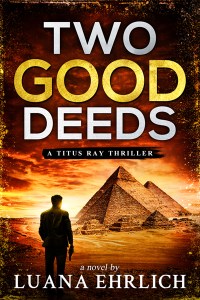
Book 7 in the Mylas Grey Mystery Series on Amazon. Click cover.

Book 4 in the Silas McKay Suspense Series on Amazon. Click cover.

Book 10 in the Titus Ray Thriller Series on Amazon. Click cover.

PREQUEL to the Mylas Grey Mystery Series on Amazon. Click cover

Book VI in the Mylas Grey Mystery Series on Amazon. Click cover

Book III in the Silas McKay Suspense Series on Amazon. Click cover

Book IX in the Titus Ray Thriller Series on Amazon. Click cover

Book V in the Mylas Grey Mystery Series on Amazon. Click cover

Book II in the Silas McKay Suspense Series on Amazon. Click cover

Book I in the Silas McKay Suspense Series, Available in Winter Deceptions

Ben in Trouble follows Four Steps Missed in the Titus Ray Thriller Series

Book IV in the Mylas Grey Mystery Series on Amazon. Click cover

Book VIII in the Titus Ray Thriller Series on Amazon. Click cover.

Ben in Charge, Follows Three Steps Away in the Titus Ray Thriller Series

Ben in Love, Follows Two Steps Forward in the Titus Ray Thriller Series

Two Days Taken:Book II in the Mylas Grey Mystery Series; Click cover.

Book VII in the Titus Ray Thriller Series on Amazon. Click on book cover

One Day Gone: Book I in the Mylas Grey Mystery Series; Click on Cover

NEWEST BOOK: Available on Amazon. Click on Cover.

Prequel to the Titus Ray Thriller Series is $0.99 on Amazon. Click book cover


Book I in the Titus Ray Thriller Series on Amazon. Click book cover


Book II in the Titus Ray Thriller Series on Amazon. Click on book cover

Book III in the Titus Ray Thriller Series on Amazon: Click on book cover


Book IV in the Titus Ray Thriller Series on Amazon. Click on book cover.


Book V in the Titus Ray Thriller Series on Amazon. Click on book cover.


Book VI in the Titus Ray Thriller Series on Amazon. Click on book cover.


Books 1 & 2 in the Titus Ray Series Available on Amazon. Click on cover.


 His Glory My Joy, a blog of Author Luana Ehrlich
You must be logged in to post a comment.