Archive
A Place To Hide

As a child, I loved playing hide and seek—yes, I suppose even back then I loved a good mystery!
What I enjoyed most about playing this game, though, was finding the perfect hiding place.
My perfect hiding place was usually somewhere unexpected, a place where no one would ever think to look for me, like the backseat of our neighbor’s car that was conveniently sitting in her driveway.
However, I only used this place once, because after I settled into the floorboard, the neighbor decided to go somewhere, and when I suddenly popped up, I nearly gave her a heart attack.
Did my parents hear about this? Oh, yeah!
There are also moments in our adult life when we need a hiding place—a place to go when things get overwhelming, when no one understands, when we need a refuge.
Our Heavenly Father understands this about His children, so naturally, He makes provision for us—He provides us with the perfect hiding place.
That perfect hiding place is in Him.
He gives us this promise in Psalm 5:11-12:
“But let all who take refuge in you rejoice;
let them ever sing for joy,
and spread your protection over them,
that those who love your name may exult in you.
For you bless the righteous, O Lord;
you cover him with favor as with a shield.“
Do you need a hiding place? He’s there waiting for you. Run to Him. Settle into His arms. Enjoy His comforting embrace.
One other note: Have you decided on a plan for reading your Bible this year? Yes, I know it’s January 12, but it’s never too late to start if you want the greatest blessing you’ll ever experience, except for your gift of salvation. Check out this link for all kinds of plans. Bible Reading Plans for you for 2026.
An Indescribable Gift

Mary gazes down on sweetness in a manger,
Bright eyes, soft skin, pure delight,
A gift from heaven.
John sees the Lamb at the Jordan,
Without spot, without blemish, without sin,
A gift from heaven.
Nicodemus questions the Rabbi in darkness,
New answers, fresh hope, glad heart,
A gift from heaven.
Zacchaeus climbs the sycamore tree,
Delighted, repentant, forgiven,
A gift from heaven.
The Savior dies on a Roman cross,
Bloodied, rejected, scorned,
A gift from heaven.
A sinner hears a message full of grace,
Good tidings, great joy, blessed hope,
A gift from heaven.
“Thanks be to God for His indescribable gift.” 2 Corinthians 9:15
I’m thankful anyway . . .

Well, it’s Thanksgiving Day, and I’m sitting here with four stitches in my mouth after having some unexpected dental surgery. No, the timing isn’t great—I’ll only be eating soft foods today—but I’m thankful anyway.
While Thanksgiving Day has morphed into being much about food, football, and family, and less about THE ONE who provided it, that doesn’t have to be the case. Being thankful is an individual choice. YOU make the decision about whether to express your gratitude for the bountiful blessings you’ve been given, and you can do that no matter what your circumstances are today.
“Give thanks in all circumstances; for this is the will of God in Christ Jesus for you.” I Thessalonians 5:18
I don’t know what your circumstances are, but here’s a short list of things I have encountered personally or counseled with others who have had to face these circumstances. There are always things to be thankful for . . . anyway.
- Chronic pain or illness — even while managing daily discomfort, you can be thankful for skilled doctors, small improvements, or the strength God gives to endure.
- Financial strain — when the budget is tight, you can still be grateful for daily provision, a friend’s generosity, or unexpected reminders of God’s care.
- Loneliness — in seasons when relationships feel distant, you can be thankful for God’s presence, moments of connection, or the hope of new friendships.
- Grief after losing someone — even in sorrow, you can be thankful for the memories, the love shared, and the comfort God provides.
- Waiting for answers or direction — in uncertainty, you can thank God for His wisdom, His timing, and the doors He will eventually open or close.
- Family conflict — though painful, you can be grateful for opportunities to grow in patience, forgiveness, and grace.
- Workplace stress — even when tasks pile up or tensions rise, you can be thankful for meaningful work, supportive coworkers, and God’s sustaining help.
- A difficult diagnosis — you can have gratitude for compassionate medical staff, treatment options, or the peace God gives when the future feels overwhelming.
- Unexpected disappointments — when plans fall apart, you can still be thankful for God’s protection, His redirection, and the lessons tucked inside the setback.
- A strained or uncertain future — even when nothing feels secure, you can be thankful for God’s promises, His faithfulness in the past, and the hope He guarantees for tomorrow.
“Oh give thanks to the Lord, for he is good, for his steadfast love endures forever!” Psalm 107:1
Need A Blessing?

When a stranger suddenly sneezed when I was standing in front of her in the check out line at a grocery store, I responded by saying, “Bless you.”
She nodded and said, “Thank you. I needed a blessing.”
Her response amused me, and as I thought about this encounter later in the day, I was curious why we say, “God bless you,” or “Bless you,” when a person sneezes.
Naturally, that led me to do a little research on it, and I discovered this practice started during the Bubonic Plaque in Europe when sneezing was seen as a symptom of the disease. Saying, “God bless you,” was a way of asking God’s protection from the disease.
As believers in Christ, we don’t have to wait for a stranger to ask God’s blessings on us after a sneeze.
We can ask God to bless us at any time, at any place, and under any circumstance.
Matthew 7:7 tells us to “Ask, and it will be given to you; seek, and you will find; knock, and the door will be opened to you.”
An Old Testament character named Jabez asked for God’s blessing in this way: “Oh that you would bless me and enlarge my border, and that your hand might be with me, and that you would keep me from harm so that it might not bring me pain!” 1 Chronicles 4:9-10.
Before asking for God’s blessing, think of all the ways He’s already blessed you—salvation, family, career, shelter, health—and then be specific in the way you want Him to bless you now.
In asking for anything from the Lord, the Bible admonishes us to examine our motivation for asking—is it in keeping with God’s will for our life and the holy life he expects us to live as His children? How do we intend to use God’s blessing—for ourselves or for others?
One of the prayers of the Apostle Paul is a good guide to follow: “God, bless me abundantly, so that in all things at all times, having all that I need, I will abound in every good work.” 2 Corinthians 9:8.
My blessing for you today is this: “The Lord bless you and keep you; the Lord make his face shine on you and be gracious to you; the Lord turn his face toward you and give you peace.” Numbers 6:24-26.
I’m Not Able

When someone makes the statement, “I’m not able,” it can be an admission of weakness, but it can also be an admission of faith.
When a person realizes they’re not able to stand before God as blameless, they’re not expressing weakness; they’re validating the truth of Romans 3:23: “For all have sinned and fall short of the glory of God.”
But that’s not the full story. Even though everyone has sinned, Hebrews 7:25 tells us that Jesus, the Son of God, “is able to save to the uttermost those who draw near to God.”
And there’s this from Jude 24, where the writer says that Jesus “is able to keep you from stumbling and to present you blameless before the presence of his glory with great joy.”
Admitting I am not able to deliver myself from my sins, nor appear before God as blameless, is an expression of faith, and accepting the truth that He is able—by means of His sacrificial death—to accomplish it, is a confession of that faith.
But that’s still not the full story. In 1 Timothy 4:12, the apostle Paul says, “I know whom I have believed, and I am convinced that he is able to guard until that day what has been entrusted to me.”
And lastly, from Hebrews 2:18: “For because he himself has suffered when tempted, he is able to help those who are being tempted.”
I am not able, but God is able.
He is able to save those who come to Him.
He is able to keep you from stumbling.
He is able to present you as blameless.
He is able to guard you.
He is able to help you in temptation.
As the apostle Paul urges us in Ephesians 3:20-21, we give Him glory for He is able.
“Now to him who is able to do far more abundantly than all that we ask or think, according to the power at work within us, to him be glory in the church and in Christ Jesus throughout all generations, forever and ever. Amen.”
A Most Unusual Christmas

No matter what age you are, you probably have a Christmas tale about a sad Christmas, one that didn’t go exactly as planned, one that was disappointing, one that was so sorrowful you can’t think about it without the tears flowing.
Or you may have a Christmas tale about a happy Christmas, one where someone surprised you with an unexpected gift, one where you reconciled with a loved one, one where everyone loved the gifts you bought them, or one where you had enough money to buy someone the gift they wanted but didn’t think they’d get.
Some of you may even have a Christmas tale about an unusual Christmas, one where events unfolded in a non-traditional way, so much so that you can remember the circumstances as if they happened yesterday.
I’ve had all of the above, and although space—and my introverted personality—doesn’t lend itself to reciting the details of each situation, here’s a partial list of my most unusual Christmases.
- A Christmas morning when a family member had a kidney stone, and we had to spend the entire day in the ER.
- A Christmas when an ice storm struck so no family members were able to make it to our house to participate in our gift-giving and holiday meal together.
- A Christmas Day when my husband, young daughter, and I had to travel to a foreign country where we would be living for the next three years—a frightening and very lonely day.
- A Christmas Eve when I had to call an ambulance for my husband, who thought he was having a heart attack. In the ER, we learned it was acute pancreatitis, and he ended up spending the next three months hooked up to an IV.
Although it may be hard to believe, I could list several more unusual Christmases during my lifetime. But strangely enough, in all of these circumstances, I found peace by focusing on the most unusual day in all of human history—the First Christmas Day—the day God arrived on planet Earth in a human body.
It was a day like no other day, an unusual day, a unique day, a day we should celebrate even if our Christmas Day ends up being sad, happy, or unusual.
Jesus tells us why in His own words. “I have come into the world as light, so that whoever believes in me may not remain in darkness.” John 12:46.
What Can I Give You?

If I asked you, “What can I give you?” you might not be as excited about the prospect of getting something from me as you would be if God Himself were to ask you that question.
After all, this is the God who made heaven and earth, who created man from a handful of dirt, who owns the cattle on a thousand hills, who speaks with the voice of thunder, who is sovereign over all His creation.
While it may sound like I’m engaging in a spiritual fantasy, this actually happened when David’s son, Solomon, was anointed King of Israel. The account is in I Kings 3. At Gibeon the Lord appeared to Solomon in a dream by night, and God said, “Ask what I shall give you.” I Kings 3:5.
Pastors and Bible teachers often use this question to get their listeners to ask themselves what they would do in this situation. “What would you say if God offered to give you anything? What is one thing you would ask God to give you?”
Although there are always some humorous answers like, “I’d ask Him for fifty more things,” most answers aren’t of a selfish nature. In moments like these, most believers focus on eternal values.
Here’s what Solomon answered: “Give your servant therefore an understanding mind to govern your people, that I may discern between good and evil, for who is able to govern this your great people?” I Kings 3:9.
Some might think God would just naturally give Solomon all he needed to do the task he had given him, and Solomon had just wasted this request by asking for wisdom. But how did God feel about it? “It pleased the Lord that Solomon had asked this.” I Kings 3:10.
It pleased Him because before Solomon asked for wisdom, he acknowledged he was humbled to be chosen as King of Israel, but he felt inadequate for the task and could only accomplish it by God’s help.
As unique as it sounds, Solomon wasn’t the only person to be given the opportunity to ask something of God. Jesus said to all believers in Matthew 7:7-8 “Ask, and it will be given to you; seek, and you will find; knock, and it will be opened to you. For everyone who asks receives, and the one who seeks finds, and to the one who knocks it will be opened.”
Like Solomon, God will be pleased to answer your request if you come with a heart of humility and selflessness, acknowledging your inadequacies, and trusting Him to answer your request in a way that honors His name.
“What can I give you?” asks God the Father, who has already given us His Son.
Comfort Food Needed

What’s your comfort food? My husband loves mashed potatoes and gravy. I love bread products. Oh, and chocolate, and maybe some cinnamon rolls thrown in too. And pizza! Don’t forget pizza.
But real comfort food can only be found in the Bible. Here are some of my favorites.
“Be strong, and let your heart take courage, all you who wait for the Lord!” Psalm 31:24.
“Our soul waits for the Lord; he is our help and our shield. For our heart is glad in him, because we trust in his holy name.” Psalm 33:20-21.
For the Lord your God is gracious and merciful and will not turn away his face from you, if you return to him.” 2 Chronicles 30:9.
Most of all, turn to the ONE who gives comfort.
“Blessed be the God and Father of our Lord Jesus Christ, the Father of mercies and God of all comfort.” 2 Corinthians 1:3
Hidden in Plain Sight

Because I write mystery/suspense/thrillers, I’m always doing research on technology like hidden cameras, spy drones, and everyday objects that can be used for surveillance. Do you know the very best place to hide something? Hide it in plain sight. People tend to overlook things that are right in front of them.
How many people look at a button on a shirt and think it could be a hidden camera? No one but a spy or a thriller writer, which is all the more reason why it’s the perfect spot for one.
But “hidden in plain sight” doesn’t just apply to spies and detectives and hidden cameras. There are all kinds of hidden words for us in Scripture—staring us right there in the face just waiting for us to discover them.
I recently discovered one of these hidden jewels in Jude. Jude? That’s right. No wonder I’ve overlooked it. How often do you read from the book of Jude? It’s the book just before Revelation, so small it doesn’t even have chapters.
Here’s a “hidden in plain sight” treasure from Jude 24-25: “Now to him who is able to keep you from stumbling and to present you blameless before the presence of his glory with great joy, to the only God, our Savior, through Jesus Christ our Lord, be glory, majesty, dominion, and authority, before all time and now and forever.”
There are several reasons why these verses got my attention, but here are just three of them: 1) God not only helps us as we struggle with sin, He’s “able to keep us from stumbling.” 2) When we appear before Him in His presence, He’ll present us blameless in His sight. 3) When he presents us blameless before His presence, he’ll do it “with great joy.”
Okay, here’s one more: So often, we think of Jesus as our Savior, and rightly so, for his sacrifice on Calvary “saved” us from the wrath of God we all deserve. Yet Jude 25 calls God the Father our Savior: “to the only God, our Savior . . .”
No wonder Jude ends his letter with a praise to Him that we give him “glory, majesty, dominion, and authority . . .”
There you go—a magnificent truth hidden in plain sight for you to treasure and enjoy.
Do You Hear Voices?

Voices! We hear voices each and every day. Some are screaming at us from the TV, telling us to order this, pay attention to that, don’t forget this. Others are posting on our Facebook page, Twitter feed, other social media sites, wanting us to sign this, like that, look at this.
Who merits our attention? To whom should we be listening? Whose voice is the worthy voice?
A crippled up old man appears in the gospel of John to answer these questions. (John 5:1-17). He doesn’t have a name in the gospel, but everyone at the pool of Bethesda knew him. He had been lying there for thirty-eight years, unable to take advantage of the pool’s healing properties. Jesus stopped by one day, and, in one instantaneous moment, took care of the crippled man’s lifelong problem.
Following Jesus’ instructions, the Man Made Whole gathered up his bedroll and walked away. Later, when asked by the religious leaders what he thought he was doing carrying his bed around on a Sabbath, he told them he was doing what he’d been instructed to do by the man who had enough authority to make him whole again.
The Man Made Whole was carrying his bed—in defiance of the religious authorities—because he recognized a man who was able to give life to his withered limbs was someone with authority, someone worthy of his attention.
This same man, Jesus of Nazareth, healed me one day.
He healed me of a lifelong sin problem, a sickness so severe I was doomed for eternal destruction. He did so by taking sin’s disease on Himself and paying the price for it Himself. Now, he commands me to take up my life and live it for Him.
His voice is a voice worth hearing.
Listen to His words from the rest of John 5, “Truly, truly, I say to you, an hour is coming, and is now here, when the dead will hear the voice of the Son of God, and those who hear will live. For as the Father has life in himself, so he has granted the Son also to have life in himself.” (25-26)


Book 8 in the Mylas Grey Mystery Series, Click on cover

Book 5 in the Silas McKay Suspense Series, Click on cover

Book 11 in the Titus Ray Thriller Series. Click cover
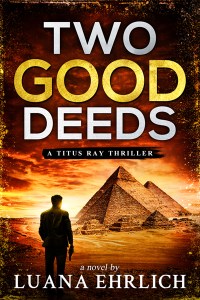
Book 7 in the Mylas Grey Mystery Series on Amazon. Click cover.

Book 4 in the Silas McKay Suspense Series on Amazon. Click cover.

Book 10 in the Titus Ray Thriller Series on Amazon. Click cover.

PREQUEL to the Mylas Grey Mystery Series on Amazon. Click cover

Book VI in the Mylas Grey Mystery Series on Amazon. Click cover

Book III in the Silas McKay Suspense Series on Amazon. Click cover

Book IX in the Titus Ray Thriller Series on Amazon. Click cover

Book V in the Mylas Grey Mystery Series on Amazon. Click cover

Book II in the Silas McKay Suspense Series on Amazon. Click cover

Book I in the Silas McKay Suspense Series, Available in Winter Deceptions

Ben in Trouble follows Four Steps Missed in the Titus Ray Thriller Series

Book IV in the Mylas Grey Mystery Series on Amazon. Click cover

Book VIII in the Titus Ray Thriller Series on Amazon. Click cover.

Ben in Charge, Follows Three Steps Away in the Titus Ray Thriller Series

Ben in Love, Follows Two Steps Forward in the Titus Ray Thriller Series

Two Days Taken:Book II in the Mylas Grey Mystery Series; Click cover.

Book VII in the Titus Ray Thriller Series on Amazon. Click on book cover

One Day Gone: Book I in the Mylas Grey Mystery Series; Click on Cover

NEWEST BOOK: Available on Amazon. Click on Cover.

Prequel to the Titus Ray Thriller Series is $0.99 on Amazon. Click book cover


Book I in the Titus Ray Thriller Series on Amazon. Click book cover


Book II in the Titus Ray Thriller Series on Amazon. Click on book cover

Book III in the Titus Ray Thriller Series on Amazon: Click on book cover


Book IV in the Titus Ray Thriller Series on Amazon. Click on book cover.


Book V in the Titus Ray Thriller Series on Amazon. Click on book cover.


Book VI in the Titus Ray Thriller Series on Amazon. Click on book cover.


Books 1 & 2 in the Titus Ray Series Available on Amazon. Click on cover.


 His Glory My Joy, a blog of Author Luana Ehrlich
You must be logged in to post a comment.