Archive
A Little Reality, Please

Most of us realize the food ads we see in magazines and on television are created by highly skilled photographers, and the food has been artfully manipulated to make it appear irresistible. A few years ago, I saw an article that described what happened when a professional photographer took pictures of the real thing and placed it alongside an appealing ad for the same product. The results were humorous, though not too surprising.
In God’s Word, He’s presented us a “photograph” of the best, His Son. Placed alongside Him, we fare badly, never able to fully measure up to His beauty, His holiness, and His lovingkindness. Just like fast food in the real world isn’t exactly like the fast food presented by the advertising world, we live in the real world and have the scars to prove it. However, one day an expert photographer will appear and airbrush away all our flaws. Then, we’ll look our best. We’ll live in the best world, and most importantly, we’ll live with The Best.
“Beloved, now are we the sons of God, and it doth not yet appear what we shall be: but we know that, when he shall appear, we shall be like him; for we shall see him as he is.” 1 John 3:2
Why Was He Born?
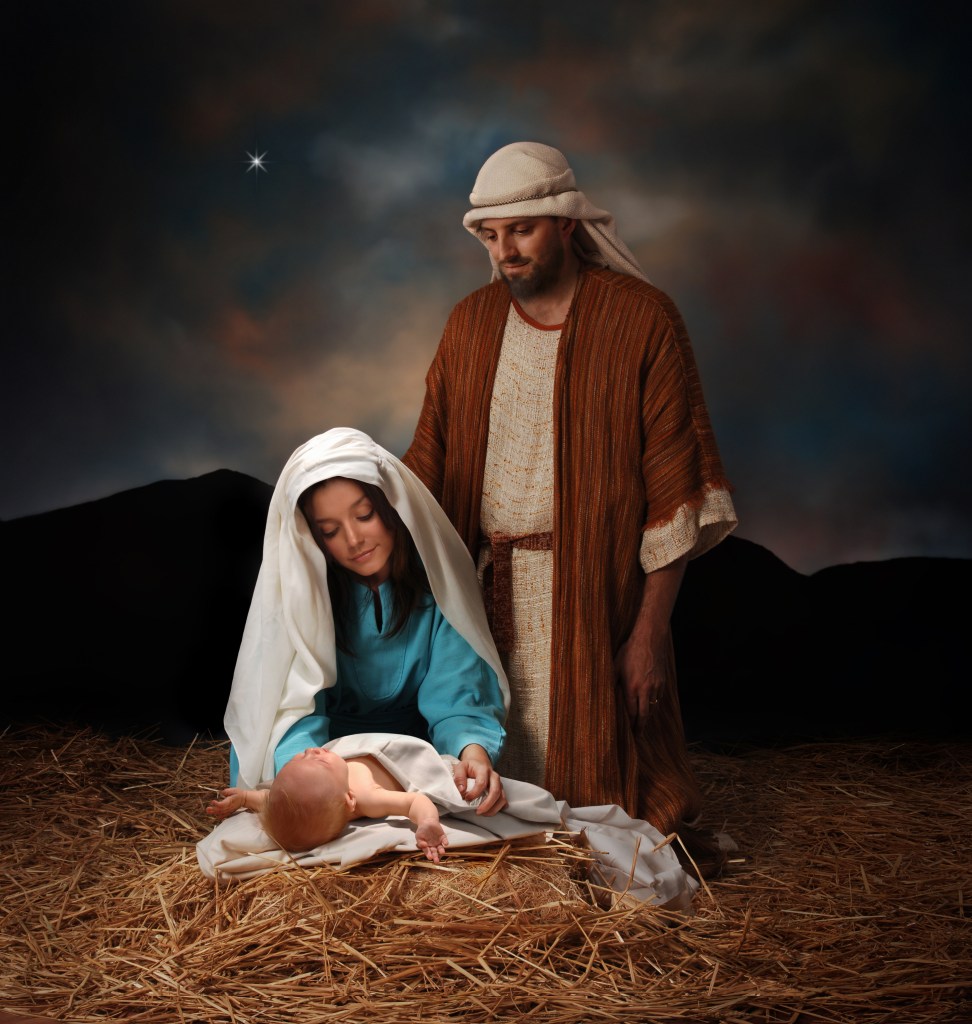
Born to be cursed, not to curse.
Born for sinners, not to sin.
Born to love, not to hate.
Born to accept, not to reject.
Born for failure, not for success.
Born to poverty, not to wealth.
Born for hope, not despair.
Born for healing, not for affliction.
Born to set free, not to bind up.
Born to reveal, not to conceal.
Born for laughter, not tears.
Born for compassion, not anger.
Born to die, not to live.
Blurry Around The Edges?

One of the great things about most cameras today is the automatic focusing feature. I’m old enough to remember using a camera that required fiddling with a bunch of dials before snapping the picture. Most of the time, those waiting to be photographed weren’t very patient about this process, and, oftentimes, after all that effort, the photo turned out to be out of focus after all.
As children of God, it would be nice to have this automatic focusing mechanism built into our daily lives, so that the moment our lives became blurry around the edges—from taking part in all the world has to offer, from neglecting Bible study, from participating in non-glorifying activities—then our focus would automatically be returned to our Father and to living out Christ in us, “the hope of Glory” (Colossians 1:27).
However, none of us have an automatic focusing mechanism. What we have is something even better—the Word of God. While having a device to automatically redirect one’s focus towards God sounds good, in reality, such a device would ultimately lead to taking God for granted, and it would not adhere to the command to “work out your salvation with fear and trembling” (Philippians 2:12).
God’s Word directs us to focus on Him in numerous passages of Scripture throughout the Old and New Testament. One of my favorites is 2 Thessalonians 3:5: “May the Lord direct your hearts to the love of God and to the steadfastness of Christ.”
Have you lost your focus? Direct your heart today to the love of God. “The love of God was made manifest among us, that God sent his only Son into the world, so that we might live through him” (1 John 4:9).
Direct your heart to the steadfastness of Christ. “He who calls you is faithful; he will surely do it” (1 Thessalonians 5:24).
Spending time with the Lord in daily Bible study brings clarity to our lives and sharpens an otherwise blurry picture.
A God Who Loves Dirt
 I love the way David describes how God treats His children in Psalm 103. David says He “satisfies your desires with good things.”(Psalm 103:5).
Later on in this Psalm, David writes, “He remembers we are but dust,” and he writes this in connection with the compassion of God. “As a father has compassion on his children, so the Lord has compassion on those who fear him; for he knows how we are formed, he remembers that we are but dust.” (Psalm 103:13-14).
God created human beings out of a common substance, a substance of little worth, just a handful of dirt. Inside this dirt-formed vessel, He placed an image of Himself. When that happened, something of little value became something of infinite value—a living human being. Every human being born after Adam reflects this God-likeness.
Even though we bear His likeness, we are still just dirt, and He remembers this. He knows our frailties, our weaknesses, our dirt, and because of this, He has compassion on us. The Psalmist says, “He crowns you with love and compassion.” (Psalm 103:4).
Even though we’re made of dirt, we have a regal bearing because, as God’s children, we wear the crown of His compassion and love. That’s why David begins and ends this Psalm with these words. “Praise the Lord, my soul; all my inmost being, praise his holy name.” (Psalm 103:22).
To Be Loved

The words, “I don’t love you,” have to be the most hurtful words ever spoken. As human beings, we are born with the desire to be loved. Whether it’s romantic love, family love, brotherly love or even self love, God gave us the desire to be loved and to love God, others, and ourselves.
Love comes from God. “Dear friends, let us love one another, for love comes from God.” (1 John 4:7).
Because human love is so flawed by sin, none of us can ever love ourselves or another human being perfectly. In the same way, until we receive our glorified, perfected bodies, we can’t love God perfectly.
God has no such hindrances. He loves perfectly. On three different occasions, the prophet Daniel was told by the angel Gabriel that he was greatly loved by God. “I have come to tell it to you, for you are greatly loved.” (Daniel 9:23). The same thought is expressed in Daniel 10: 11 and Daniel 10:19.
How sweet those words must have sounded to Daniel! How would you like to hear those words for yourself? Well, you can.
Paul says in Ephesians 2:4-5: “God, being rich in mercy, because of the great love with which he loved us, even when we were dead in our trespasses,made us alive together with Christ.”
God’s love is on display for us in Romans 5:8.“But God shows his love for us in that while we were still sinners, Christ died for us.”
Like Daniel, God sent word to us that we are greatly love. He sent His Word in the form of His Son who demonstrated how much he really loved us by paying the penalty for our sins by His death on the cross
Accept His love. Bask in His Love. Know His love for all eternity.
It’s About Knowing God

I was talking with a young lady who’d been a believer for several years, but who decided to sign up for a weekly Bible study. She said, “I want to know God. I know that won’t happen if I don’t study my Bible.”
Without realizing it, this young lady had made a profound statement. There’s no way anyone can know God except through the study of Scriptures, because that’s the way He’s chosen to reveal Himself to us.
Thus, the best way to get to know God is to read, study, and meditate on the love letter He’s written to us in the Scriptures.
I met my husband-to-be one summer when I was sixteen years old, but we lived a thousand miles away from each other during the school year, so we never had the opportunity to spend any time together. I understood now why my friends and family were surprised when I announced that James and I were getting married only a couple of months after my eighteenth birthday. What they failed to grasp was that James and I had been corresponding with each other regularly for almost two years, and because of those letters, we’d come to know each other as well as many couples who’d been dating for several years.
While this illustrates the concept of getting to know God through reading His Word, it fails to portray the real picture of how intimacy with God is possible through the study of His Word.
This truth can only be experienced when a believer spends time in the Word every day. This is the way God has chosen to build a relationship with His children. This is the way God speaks to His children, and this is the way His children learn to recognize the voice of the Father.
Jesus said His followers are able to recognize His voice. John 10:27, “My sheep hear my voice, and I know them, and they follow me.”
If you truly “want to know God,” become familiar with the sound of His voice through His Word.
To See Light, Be in The Light

Summer is fast approaching, and while Fall is my favorite time of the year, I also enjoy the summer months because I love sunshine.
Light brightens my soul, both literally and figuratively. There’s a wonderful verse in Psalm 36:9, which I have always found fascinating.
“For with you is the fountain of life; in your light do we see light.”
It’s intriguing because it seems to imply the more we walk in His Light, the more we see His Light.
I know the opposite is true, that is, the more we dwell on the dark things of this world, the darker we become, so perhaps this verse isn’t that surprising.
Another similar verse in I John 1:5 teaches us the same thing. “God is light, and in him there is no darkness at all.”
While there are many aspects of our world today that seem to be dark, we are not left without light. We can always look to the one in whom is no darkness.
We can look to “the light of the glory of God as seen in the face of Jesus Christ.” II Corinthians 4:6.
The Being of “Not”

I’ve always been fascinated by what John the Baptist said when someone asked him if he was the long-awaited promised Messiah. “I am not the Messiah,” he said (John 1:20).
Why does his answer fascinate me?
First, since they asked him the question, some in the crowd obviously thought he might be the Messiah. The gospel writers don’t tell us whether it was his dress, his demeanor, or his preaching, but evidently some saw this as a possibility.
John could have claimed the title easily enough.
He had an extraordinary, miraculous birth. An angel appeared in person to his father to announce his birth. His mother had been unable to have children, and she was already past the age of bearing children when she got pregnant, plus his father lost his ability to speak throughout his wife’s pregnancy, and his voice only returned when John was born.
But John refused the title of Messiah, despite the fact it would have made him even more popular and more people would have been drawn to him to hear his message.
“I am not the Messiah.”
His answer also fascinates me because by knowing who he was not, John is also indicating he knows who he is. Although he is not the Messiah, he is someone with a message and a mission.
Luke 3:3 says, “And he went into all the region around the Jordan, proclaiming a baptism of repentance for the forgiveness of sins.”
In John’s declaration of “I am not the Messiah,” I find a powerful truth for how God calls me to live my own life. Knowing who I am not—whether it’s an age, a career, a family role, a ministry—is the key to knowing who I am.
No matter who I am not, God has given me a message and a mission, and like John, this message and mission will ultimately point away from me and to the true Messiah.
When John was baptizing one day, he saw Jesus walking along the banks of the Jordan River and he said to those around him, “Behold, the Lamb of God, who takes away the sin of the world!” (John 1:29).
I am not the Messiah, but I know the Messiah who has taken away the sins of the world.
You can know the Messiah too. Learn more here.
Do You Hear Voices?

Voices! We hear voices each and every day. Some are screaming at us from the TV, telling us to order this, pay attention to that, don’t forget this. Others are posting on our Facebook page, Twitter feed, other social media sites, wanting us to sign this, like that, look at this.
Who merits our attention? To whom should we be listening? Whose voice is the worthy voice?
A crippled up old man appears in the gospel of John to answer these questions. (John 5:1-17). He doesn’t have a name in the gospel, but everyone at the pool of Bethesda knew him. He had been lying there for thirty-eight years, unable to take advantage of the pool’s healing properties. Jesus stopped by one day, and, in one instantaneous moment, took care of the crippled man’s lifelong problem.
Following Jesus’ instructions, the Man Made Whole gathered up his bedroll and walked away. Later, when asked by the religious leaders what he thought he was doing carrying his bed around on a Sabbath, he told them he was doing what he’d been instructed to do by the man who had enough authority to make him whole again.
The Man Made Whole was carrying his bed—in defiance of the religious authorities—because he recognized a man who was able to give life to his withered limbs was someone with authority, someone worthy of his attention.
This same man, Jesus of Nazareth, healed me one day.
He healed me of a lifelong sin problem, a sickness so severe I was doomed for eternal destruction. He did so by taking sin’s disease on Himself and paying the price for it Himself. Now, he commands me to take up my life and live it for Him.
His voice is a voice worth hearing.
Listen to His words from the rest of John 5, “Truly, truly, I say to you, an hour is coming, and is now here, when the dead will hear the voice of the Son of God, and those who hear will live. For as the Father has life in himself, so he has granted the Son also to have life in himself.” (25-26)
Begin Anew

Goodbye, 2020!
January 1st is a day of HOPE. To many, it holds the enticing thought of a brand new start, a day to wipe the slate clean, to begin anew.
- We hope to lose weight, get more sleep, eat healthy.
- We hope to be more productive, get organized.
- We hope to get a better job, earn more money.
But, so much of what we hope for tomorrow will just be wishful thinking.
There’s a different kind of hope that’s not just wishful thinking. It’s a hope centered on Christ, a confidence that what God has promised He’ll bring to pass. I like to think of hope as the future tense of faith.
How can we have this hope that’s not just wishful thinking? Romans 10:17 says, “Faith comes by hearing and hearing by the Word of God.” It’s the Word of God that makes faith and hope possible.
All of your days in 2021 can be A Day of Hope by reading God’s Word.
Check out these Daily Bible Reading Plans for hope-filled days in 2021.


Book 8 in the Mylas Grey Mystery Series, Click on cover

Book 5 in the Silas McKay Suspense Series, Click on cover

Book 11 in the Titus Ray Thriller Series. Click cover
Book 7 in the Mylas Grey Mystery Series on Amazon. Click cover.

Book 4 in the Silas McKay Suspense Series on Amazon. Click cover.

Book 10 in the Titus Ray Thriller Series on Amazon. Click cover.

PREQUEL to the Mylas Grey Mystery Series on Amazon. Click cover

Book VI in the Mylas Grey Mystery Series on Amazon. Click cover

Book III in the Silas McKay Suspense Series on Amazon. Click cover

Book IX in the Titus Ray Thriller Series on Amazon. Click cover

Book V in the Mylas Grey Mystery Series on Amazon. Click cover

Book II in the Silas McKay Suspense Series on Amazon. Click cover

Book I in the Silas McKay Suspense Series, Available in Winter Deceptions

Ben in Trouble follows Four Steps Missed in the Titus Ray Thriller Series

Book IV in the Mylas Grey Mystery Series on Amazon. Click cover

Book VIII in the Titus Ray Thriller Series on Amazon. Click cover.

Ben in Charge, Follows Three Steps Away in the Titus Ray Thriller Series

Ben in Love, Follows Two Steps Forward in the Titus Ray Thriller Series

Two Days Taken:Book II in the Mylas Grey Mystery Series; Click cover.

Book VII in the Titus Ray Thriller Series on Amazon. Click on book cover

One Day Gone: Book I in the Mylas Grey Mystery Series; Click on Cover

NEWEST BOOK: Available on Amazon. Click on Cover.

Prequel to the Titus Ray Thriller Series is $0.99 on Amazon. Click book cover


Book I in the Titus Ray Thriller Series on Amazon. Click book cover


Book II in the Titus Ray Thriller Series on Amazon. Click on book cover

Book III in the Titus Ray Thriller Series on Amazon: Click on book cover


Book IV in the Titus Ray Thriller Series on Amazon. Click on book cover.


Book V in the Titus Ray Thriller Series on Amazon. Click on book cover.


Book VI in the Titus Ray Thriller Series on Amazon. Click on book cover.


Books 1 & 2 in the Titus Ray Series Available on Amazon. Click on cover.


 His Glory My Joy, a blog of Author Luana Ehrlich
You must be logged in to post a comment.