Archive
God Loves You
 The words, “I don’t love you,” have to be the most hurtful words ever spoken. As human beings, we are born with the desire to be loved. Whether it’s romantic love, family love, brotherly love or even self love, God gave us the desire to be loved and to love God, others, and ourselves.
Love comes from God. “Dear friends, let us love one another, for love comes from God.” (1 John 4:7).
Because human love is so flawed by sin, none of us can ever love ourselves or another human being perfectly. In the same way, until we receive our glorified, perfected bodies, we can’t love God perfectly.
God has no such hindrances. He loves perfectly. On three different occasions, the prophet Daniel was told by the angel Gabriel that he was greatly loved by God. “I have come to tell it to you, for you are greatly loved.” (Daniel 9:23). The same thought is expressed in Daniel 10: 11 and Daniel 10:19.
How sweet those words must have sounded to Daniel! How would you like to hear those words for yourself? Well, you can.
Paul says in Ephesians 2:4-5: “God, being rich in mercy, because of the great love with which he loved us, even when we were dead in our trespasses,made us alive together with Christ.”
God’s love is on display for us in Romans 5:8.“But God shows his love for us in that while we were still sinners, Christ died for us.”
Like Daniel, God sent word to us that we are greatly love. He sent His Word in the form of His Son who demonstrated how much he really loved us by paying the penalty for our sins by His death on the cross
Accept His love. Bask in His Love. Know His love for all eternity.
How Can I Believe in God?
 I’ve never had a problem believing in God. It’s as natural to me as breathing.
That doesn’t mean I’ve ever seen God, or had an angelic visitation, or received some special sign from Him. I’ve never seen any writing on the wall or heard an audible voice, or had some tangible proof He’s real.
My belief in God comes from trust. I trust what the Bible tells me about God. Ironically, the faith to believe in Him, to trust what the Scriptures tell me about Him, is a gift from God.
Ephesians 2:8-9 says, “For by grace you have been saved through faith. And this is not your own doing; it is the gift of God, not a result of works, so that no one may boast.”
Believing in God is not something I can do for myself. The ability to believe in God comes from God.
Any person who sincerely wants to know God will find Him. “You will seek me and find me when you seek me with all your heart.” Jeremiah 29:13.
I believe in God because He created the desire for me to believe in Him; He provided the means for me to believe in Him, and He made the provision for me to believe in Him.
And, He didn’t just do it for me; He did it for you as well.
John 3:16: “For God so loved the world, that he gave his only Son, that whoever believes in him should not perish but have eternal life.”
Just A Little Nudge
 Sometimes, all it takes is a nudge. I’m especially susceptible to nudges. I probably wouldn’t have started writing my Titus Ray Thrillers, if someone hadn’t casually mentioned to me I should try writing a spy novel. Every day I enjoy a few minutes of mind-stimulating fun playing a word game on my iPad called Word with Friends, but if a very good friend hadn’t given me a little push to put the app on my iPhone, I wouldn’t have done so.
And, sometimes, a little nudge may be all a person needs to come to Christ, or to renew their commitment to Him, or to read their Bible or to . . .
Last week, I heard about a style of evangelism that’s become popular after a book was written about it five years ago. The book is called Nudge by Leonard Sweet. In it, Sweet says that “sharing the gospel should be a matter of awakening each other to the God who’s already there.”
Sweet writes, “Nudge evangelism is based on a simple premise: in everyone you meet, leave an impression–a Jesus impression, a Jesus dent. The nudge can be as simple as a smile, as profound as a prayer, as complex as a meal, as subtle as a story, as venturous as a witness, as ambitious as an altar call.”
To nudge someone toward Christ is vastly different from shoving them toward Christ. The gospels give a clear picture of how Jesus offered Himself to unbelievers. “Come unto me,” He said. If someone rejected the offer, Jesus was saddened by such a response, but He didn’t call them out, pronounce curses on them, or show animosity of any kind toward them. And yet, more than any other being in existence, He would have been justified in doing so.
Nudging people toward Christ can happen all the time in hundreds of different ways, and the form it takes is totally dependent on a person’s personality type. Extroverts will be more aggressive in calling attention to how Jesus is working in their lives but the quiet, thoughtful attitude of an introvert can be equally as effective.
As long as I keep one thing in mind, it’s easy for me to practice this kind of nudge evangelism. I remind myself that every person I encounter in my life—from grocery clerk to business man, from stranger to friend—is someone God has placed there, is someone God has prepared for me to nudge toward Him, is someone He loves.
Give someone a little nudge toward Jesus today. It may be all they need to discover the hidden treasure of Christ Himself.
1 Peter 2: 15-16 “For this is the will of God, that by doing good you should put to silence the ignorance of foolish people. Live as people who are free, not using your freedom as a cover-up for evil, but living as servants of God.”
Now That’s Good Advice!
 Here are four pieces of advice I wish I’d been given much earlier in life.
1. Your greatest asset isn’t your own abilities. While you may have been told all you need to do is work hard and keep on keeping on, don’t believe it. Your greatest asset is your utter dependence on God. “Apart from me, you can do nothing.” John 15:5.
2. Your desire to have applause isn’t in keeping with the gospel. While our sinful nature is bent toward making much of ourselves and looking out for our own interests, the gospel tells us to make much of Jesus and look out for His Kingdom. “But seek first the kingdom of God and his righteousness, and all these things will be added to you.” Matthew 6:33.
3. You have no idea what God is doing in your life. There’s no blueprint, formula, or method out there which will enable you to gauge what God is doing in your life. It simply doesn’t exist. If it did, you wouldn’t rely on God when He takes you to places you wouldn’t ordinarily go and has you do things you aren’t equipped to handle. God is too delighted in seeing your faith grow to tell you what He’s up to. Most of what He’s doing can only be understood through a rear view mirror. “For we walk by faith, and not by sight.” 2 Corinthians 5:7.
4. You could be one incredible piece of work if you’re willing to admit you’re not. If God’s Word is any gauge of how God operates–and it most definitely is–then He uses the weak, the nobody, the frightened soul, the lowly, and the despised to be a blessing and give Him glory. If you’re willing to be a piece of clay in the potter’s hands, He’s willing to fashion you into a beautiful vessel for His Kingdom’s work. “But now, O Lord, you are our Father; we are the clay, and you are our potter.” Isaiah 64:8.
What Story Will You Tell?
 All of us have a story. It may be your parenting story, your pregnancy story, your career story or the story of your life. A story I’ve always enjoyed hearing is the story of someone’s salvation—all the details surrounding how a person came to faith in Christ.
When we lived in Indiana back in the late 1980’s, the editor of our denomination’s weekly state paper, The Indiana Baptist, asked me to do a weekly column on a different individual each week and emphasize the details of their conversion experience. I decided to call the column “A Story To Tell.”
My husband’s job at that time was in Baptist missions, and we traveled to a different church in Indiana every week. We usually arrived at the church at least an hour before he was to preach, so I had time to seek out a friendly man or woman, get their permission to record our conversation, and then ask them to tell me their salvation experience. After the interview, I would write down our conversation in a story format.
While all the stories culminated when the person became a born-again Christian, each convert’s circumstances were unique. However, after several months of writing salvation stories, the common thread I saw in each person’s experience was the way God used a friend, a neighbor, a relative, or even a stranger to draw the unsaved person to Christ.
An example of this was the young man who had not been brought up in the church, knew nothing of the Lord and was planning on becoming a professional golfer. One evening, when he was about to enter a nightclub to enjoy several hours of partying, he noticed a group of people carrying picket signs. They were protesting what was going on inside the establishment. One of the signs read “The wages of sin is death.”
For weeks the young man was haunted by these words, but he had no idea what they meant. However, after he followed his girlfriend’s suggestion to talk to a pastor, he was led to the Lord, and his life was forever transformed.
I’m sure the man who had picketed the nightclub that night carrying a sign with the words from Romans 6:23 written on it, never realized his small gesture eventually made an eternal difference in someone’s life.
What difference will you make in someone’s salvation story?
What’s Your Name?
 Deciding what to name a child can be challenging. While I’ve passed the stage of naming babies, today, I’m faced with what to name a character in a book. That too can prove challenging.
When a character enters a scene, the person’s name usually pops in my head at the same time. However, before accepting this moniker as the appropriate tag for the person, I do a little research just to make sure it isn’t the name of a celebrity or a politician or some other famous person.
I also want a villain’s name to sound . . . well . . . villainous, and a strong character to have a strong sounding name. Think “Rocky” and you get the picture.
The Bible is full of great names for both babies and characters. These are names that have been around for thousands of years, and have quite literally stood the test of time. But, there are many “one time use” names in the Bible as well.
For instance, in the book of Hosea, God instructs a prophet to name his daughter “No Mercy” (Hosea 1:6). The son who came later was named “Not My People” (Hosea 1:9). Their Hebrew names Lo-ruhama and Lo-ammi never quite caught on as popular names for offspring, but those names portrayed the message God was endeavoring to send His people at that time.
In the book of Ruth, a widow named Naomi, who had lost two sons, decided she wanted to be called Bitter. She wanted this name change because she said, “the Almighty has dealt bitterly with me” (Ruth 1:20).
If you wanted a name to reflect how God has dealt with you, what would you call yourself?
I would call myself Blessed. I pray it would be your name as well. We are all Blessed.
“Blessed is he whose help is the God of Jacob, whose hope is in the Lord his God.”
Psalm 146:5
By His Stripes We Are Healed

of black and blue and red
of gashes and slashes and stripes
of hits and harm and hurt
He stumbles and bows and falls
He crumbles and bends and kneels
He gasps and cries and moans
for healing and helping and teaching
for blessing and loving and keeping
for hoping and holding and saving
Isaiah 54:4-5
A Devotional Poem by Luana Ehrlich
Being Afraid of God
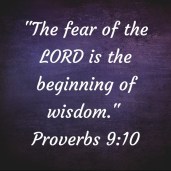 Be afraid. Be very afraid. Being afraid of God seems foreign to those of us who view God as the Lover of our Soul, who sing of His blessings, and who trust Him with our eternal soul.
Yet, one can’t read the Bible without encountering the oft-repeated admonition to “fear the Lord.” Throughout the Old Testament, there are numerous examples of God’s children receiving a blessing because they fear God. Also, because of fearing God, they do what He commands them to do. (Genesis 42:18; Exodus 1:17; Exodus 18:21)
Fear of God is not just an Old Testament concept, though. Jesus said in Matthew 10:28, “Don’t be afraid of those who want to kill your body; they cannot touch your soul. Fear only God, who can destroy both soul and body in hell.”
Nevertheless, there are times in my life when I’ve struggled with the concept of what it means to fear God. That’s why, when I recently came across a definition of fearing God in Drew Dyck’s book, Yawning At Tigers: You Can’t Tame God, So Stop Trying, I spent time meditating on it.
Dyck says, “To fear the Lord is to be grounded in reality, to have an accurate view of God’s holy nature and his awesome power.”
Fearing God doesn’t mean we cower in His presence—like a dog who knows he’s displeased his master—nor does it mean we run and hide instead of joyfully approaching Him. Instead, we embrace the fear of God because we recognize His to-be-feared characteristics, such as His all-powerful wrath toward sin, His unending sovereignty, and His unapproachable holiness, are an accurate understanding of who God really is.
The fearfulness of God is a reality, even if we don’t like it very much.
Having a true picture of God is the beginning of wisdom. Proverbs 9:10: “The fear of the LORD is the beginning of wisdom, and the knowledge of the Holy One is insight.”
We should fear God. We should be in awe of His wrath and His judgment. Yet, at the same time, we should have peace, knowing He is shielding us from wrath, sheltering us in His arms forever.
 Goodbye, 2018. Hello, 2019.
Is it possible to know God?
 I was talking with a young lady who’d been a believer for several years, but who’d recently signed up for a weekly Bible study. She said, “I want to know God. I know that won’t happen if I don’t study my Bible.”
Without realizing it, this young lady had made a profound statement. There’s no way anyone can know God except through the study of Scriptures, the revelation He’s given us about Himself. The best way to learn about God is to read, study, and meditate on the love letter He’s written to us.
Although I met my husband-to-be when I was sixteen years old, we lived a thousand miles away from each other and never had the opportunity to spend any time together. I understood why my friends and family were surprised when I announced that James and I were getting married only a couple of months after my eighteenth birthday. What they failed to grasp was that James and I had been corresponding with each other regularly for almost two years, and because of those letters, we’d come to know each other as well as many couples who’d been dating for several years.
While this illustrates the concept of getting to know God through reading His Word, it fails to portray the real picture of how intimacy with God is possible through the study of His Word.
This truth can only be experienced when a believer spends time in the Word every day. This is the way God has chosen to build a relationship with His children. This is the way God speaks to His children, and this is the way His children learn to recognize the voice of the Father.
Jesus said His followers are able to discern His voice. John 10:27, “My sheep hear my voice, and I know them, and they follow me.”
If you truly “want to know God,” become familiar with the sound of His voice through His Word.


Book 8 in the Mylas Grey Mystery Series, Click on cover

Book 5 in the Silas McKay Suspense Series, Click on cover

Book 11 in the Titus Ray Thriller Series. Click cover
Book 7 in the Mylas Grey Mystery Series on Amazon. Click cover.

Book 4 in the Silas McKay Suspense Series on Amazon. Click cover.

Book 10 in the Titus Ray Thriller Series on Amazon. Click cover.

PREQUEL to the Mylas Grey Mystery Series on Amazon. Click cover

Book VI in the Mylas Grey Mystery Series on Amazon. Click cover

Book III in the Silas McKay Suspense Series on Amazon. Click cover

Book IX in the Titus Ray Thriller Series on Amazon. Click cover

Book V in the Mylas Grey Mystery Series on Amazon. Click cover

Book II in the Silas McKay Suspense Series on Amazon. Click cover

Book I in the Silas McKay Suspense Series, Available in Winter Deceptions

Ben in Trouble follows Four Steps Missed in the Titus Ray Thriller Series

Book IV in the Mylas Grey Mystery Series on Amazon. Click cover

Book VIII in the Titus Ray Thriller Series on Amazon. Click cover.

Ben in Charge, Follows Three Steps Away in the Titus Ray Thriller Series

Ben in Love, Follows Two Steps Forward in the Titus Ray Thriller Series

Two Days Taken:Book II in the Mylas Grey Mystery Series; Click cover.

Book VII in the Titus Ray Thriller Series on Amazon. Click on book cover

One Day Gone: Book I in the Mylas Grey Mystery Series; Click on Cover

NEWEST BOOK: Available on Amazon. Click on Cover.

Prequel to the Titus Ray Thriller Series is $0.99 on Amazon. Click book cover


Book I in the Titus Ray Thriller Series on Amazon. Click book cover


Book II in the Titus Ray Thriller Series on Amazon. Click on book cover

Book III in the Titus Ray Thriller Series on Amazon: Click on book cover


Book IV in the Titus Ray Thriller Series on Amazon. Click on book cover.


Book V in the Titus Ray Thriller Series on Amazon. Click on book cover.


Book VI in the Titus Ray Thriller Series on Amazon. Click on book cover.


Books 1 & 2 in the Titus Ray Series Available on Amazon. Click on cover.


 His Glory My Joy, a blog of Author Luana Ehrlich
You must be logged in to post a comment.