Archive
Get A Grip

I thought of the expression,“get a grip,” the other day when I had to face the reality of a serious medical condition that I’ve been dealing with for the past several months, a medical condition that’s going to require surgery to fix it—brain surgery.
The medical condition I’ve been having is Trigeminal Neuralgia, and the neurosurgeon at OU Medical Center told me that he would perform a Microvascular Decompression on my brain to correct it.
However, when I thought of the phrase, “get a grip,” I wasn’t thinking in terms of its usual usage, that is, I wasn’t telling myself to control my emotions so I wouldn’t have a breakdown when I heard what the surgeon said he needed to do.
This surgery requires him to remove a portion of my skull near my ear and separate the superior cerebellar artery in my brain from the trigeminal nerve that controls the feeling in my face. (This artery sits so close to the trigeminal nerve that it has worn it down on the right side of my brain, which is why it’s continually sending painful electrical shocks to the right side of my face, and unfortunately, I’m allergic to the medicines that are usually able to control this condition.)
When I heard what the surgeon said he needed to do, instead of thinking about the usual meaning of “get a grip,” I thought about all the Scriptures that assure me that God will give me strength and uphold me during the difficult times I face in my life—a promise He’s given to all believers.
Isaiah 41:10 is one of those verses: “Fear not, for I am with you; be not dismayed, for I am your God; I will strengthen you, I will help you, I will uphold you with my righteous right hand.”
Not only does God uphold me—that is, He grips me tight—He also tells me to hold onto Him—yes, He’s told me to get a grip on Him.
A verse that says this very thing is Proverbs 4:13: “Take hold of my instructions; don’t let them go. Guard them, for they are the key to life.”
As I undergo this procedure and the recovery period that follows—which could be several weeks—I’m going to “get a grip”by holding on to everything God has promised me in His Word, all those verses that assure me that whatever He allows to come into my life has first passed through His hands and will ultimately bring Him glory and be for my good and benefit.
These are the same promises you can lean on to “get a grip” during the trials you’re facing. I’ve listed a few of those promises below, but there are many more in His Word.
Joshua 1:9—“Do not be afraid or discouraged, for the Lord your God is with you wherever you go.”
Psalm 73:26—“My flesh and my heart may fail, but God is the strength of my heart and my portion forever.”
Philippians 4:13—“I can do all things through him who strengthens me.”
It’s Not The End

It’s not the end of the story! Have you ever come to the end of a book, where the inevitable conflicts have been resolved, and you were reading the last chapter, and yet, you felt a little unsatisfied with how the story ended?
Then, at that moment, just when you were trying to come to grips with your feelings, you turned the page and found another chapter?
What a relief!
That’s what happens in the gospel of Matthew when Jesus is crucified. He’s dead. The body’s in the grave. The disciples have been grieving for three days. His enemies are happy. At last, He’s gone. End of Matthew chapter 27.
But it’s not the end.
Turn the page. There’s another chapter. Chapter 28. A big chapter. A significant chapter. A life-changing chapter.
Jesus isn’t dead. Yes, He died. There was no doubt about that—the Roman soldiers thrust a sword through His side just to make sure He was dead.
But, because He lived a sinless life, the breath of life, God’s breath, returned, and He walked out of that grave to a new life, a different life, a resurrected life.
Now, here’s one of the best parts about this very true story: this immortal life, this eternal life, is available to anyone who’s willing who put their trust in Him.
John 11:25-26: “Jesus said to her, “I am the resurrection and the life. The one who believes in me will live, even though they die; and whoever lives by believing in me will never die.”
Believe me, the life story of anyone who does that will end well.
In fact, their story will continue for all eternity.
A Place To Hide

As a child, I loved playing hide and seek—yes, I suppose even back then I loved a good mystery!
What I enjoyed most about playing this game, though, was finding the perfect hiding place.
My perfect hiding place was usually somewhere unexpected, a place where no one would ever think to look for me, like the backseat of our neighbor’s car that was conveniently sitting in her driveway.
However, I only used this place once, because after I settled into the floorboard, the neighbor decided to go somewhere, and when I suddenly popped up, I nearly gave her a heart attack.
Did my parents hear about this? Oh, yeah!
There are also moments in our adult life when we need a hiding place—a place to go when things get overwhelming, when no one understands, when we need a refuge.
Our Heavenly Father understands this about His children, so naturally, He makes provision for us—He provides us with the perfect hiding place.
That perfect hiding place is in Him.
He gives us this promise in Psalm 5:11-12:
“But let all who take refuge in you rejoice;
let them ever sing for joy,
and spread your protection over them,
that those who love your name may exult in you.
For you bless the righteous, O Lord;
you cover him with favor as with a shield.“
Do you need a hiding place? He’s there waiting for you. Run to Him. Settle into His arms. Enjoy His comforting embrace.
One other note: Have you decided on a plan for reading your Bible this year? Yes, I know it’s January 12, but it’s never too late to start if you want the greatest blessing you’ll ever experience, except for your gift of salvation. Check out this link for all kinds of plans. Bible Reading Plans for you for 2026.
I’m thankful anyway . . .

Well, it’s Thanksgiving Day, and I’m sitting here with four stitches in my mouth after having some unexpected dental surgery. No, the timing isn’t great—I’ll only be eating soft foods today—but I’m thankful anyway.
While Thanksgiving Day has morphed into being much about food, football, and family, and less about THE ONE who provided it, that doesn’t have to be the case. Being thankful is an individual choice. YOU make the decision about whether to express your gratitude for the bountiful blessings you’ve been given, and you can do that no matter what your circumstances are today.
“Give thanks in all circumstances; for this is the will of God in Christ Jesus for you.” I Thessalonians 5:18
I don’t know what your circumstances are, but here’s a short list of things I have encountered personally or counseled with others who have had to face these circumstances. There are always things to be thankful for . . . anyway.
- Chronic pain or illness — even while managing daily discomfort, you can be thankful for skilled doctors, small improvements, or the strength God gives to endure.
- Financial strain — when the budget is tight, you can still be grateful for daily provision, a friend’s generosity, or unexpected reminders of God’s care.
- Loneliness — in seasons when relationships feel distant, you can be thankful for God’s presence, moments of connection, or the hope of new friendships.
- Grief after losing someone — even in sorrow, you can be thankful for the memories, the love shared, and the comfort God provides.
- Waiting for answers or direction — in uncertainty, you can thank God for His wisdom, His timing, and the doors He will eventually open or close.
- Family conflict — though painful, you can be grateful for opportunities to grow in patience, forgiveness, and grace.
- Workplace stress — even when tasks pile up or tensions rise, you can be thankful for meaningful work, supportive coworkers, and God’s sustaining help.
- A difficult diagnosis — you can have gratitude for compassionate medical staff, treatment options, or the peace God gives when the future feels overwhelming.
- Unexpected disappointments — when plans fall apart, you can still be thankful for God’s protection, His redirection, and the lessons tucked inside the setback.
- A strained or uncertain future — even when nothing feels secure, you can be thankful for God’s promises, His faithfulness in the past, and the hope He guarantees for tomorrow.
“Oh give thanks to the Lord, for he is good, for his steadfast love endures forever!” Psalm 107:1
I Got Irritated

On a visit to Sam’s Club the other day, I got mildly irritated—not angry or mad—just irritated.
It happened as I came into the produce section and went by an area of the store where a Sam’s Club worker was putting oranges through a machine to make freshly squeezed orange juice.
I usually enjoy the tangy fragrance as I go through the aisles selecting the produce I need, but today, I was assaulted by a high-pitched noise coming from the machinery that automatically squeezes the oranges to produce the juice.
As I passed other customers, they gave me a smile, so I felt sure they were as irritated as I was that someone in management hadn’t shut the machine down.
The noise seemed to be getting worse as I hurried to make my selections and move out of the area, and for a brief moment, I considered saying something to the person restocking the apples.
Instead, I quickly made my way over to the dairy section.
But, despite the fact I’d moved several feet away, I could still hear the high-pitched squeaking.
Suddenly, it dawned on me.
I was the one causing the irritating noise.
Or rather, as I made my way around the store, the squeaky wheels on my cart were responsible for the awful racket.
While I’d been blaming everyone else for my discomfort, I was responsible for it all along.
I immediately found myself smiling, and yes, I saw a lesson in it as well.
The fact that I was looking somewhere else for the source of my irritation reminded me of Jesus’ words in Matthew 7:3-5: “Why do you see the speck that is in your brother’s eye, but do not notice the log that is in your own eye? … First take the log out of your own eye, and then you will see clearly to take the speck out of your brother’s eye.”
It was a reminder that before blaming someone else for whatever is bothering me, I should examine myself first.
Once I’ve looked inward, I may not need to look outward.
James 1: 14-15: “But each person is tempted when he is lured and enticed by his own desire. Then desire when it has conceived gives birth to sin, and sin when it is fully grown brings forth death.”
Need A Blessing?

When a stranger suddenly sneezed when I was standing in front of her in the check out line at a grocery store, I responded by saying, “Bless you.”
She nodded and said, “Thank you. I needed a blessing.”
Her response amused me, and as I thought about this encounter later in the day, I was curious why we say, “God bless you,” or “Bless you,” when a person sneezes.
Naturally, that led me to do a little research on it, and I discovered this practice started during the Bubonic Plaque in Europe when sneezing was seen as a symptom of the disease. Saying, “God bless you,” was a way of asking God’s protection from the disease.
As believers in Christ, we don’t have to wait for a stranger to ask God’s blessings on us after a sneeze.
We can ask God to bless us at any time, at any place, and under any circumstance.
Matthew 7:7 tells us to “Ask, and it will be given to you; seek, and you will find; knock, and the door will be opened to you.”
An Old Testament character named Jabez asked for God’s blessing in this way: “Oh that you would bless me and enlarge my border, and that your hand might be with me, and that you would keep me from harm so that it might not bring me pain!” 1 Chronicles 4:9-10.
Before asking for God’s blessing, think of all the ways He’s already blessed you—salvation, family, career, shelter, health—and then be specific in the way you want Him to bless you now.
In asking for anything from the Lord, the Bible admonishes us to examine our motivation for asking—is it in keeping with God’s will for our life and the holy life he expects us to live as His children? How do we intend to use God’s blessing—for ourselves or for others?
One of the prayers of the Apostle Paul is a good guide to follow: “God, bless me abundantly, so that in all things at all times, having all that I need, I will abound in every good work.” 2 Corinthians 9:8.
My blessing for you today is this: “The Lord bless you and keep you; the Lord make his face shine on you and be gracious to you; the Lord turn his face toward you and give you peace.” Numbers 6:24-26.
I’m Not Able

When someone makes the statement, “I’m not able,” it can be an admission of weakness, but it can also be an admission of faith.
When a person realizes they’re not able to stand before God as blameless, they’re not expressing weakness; they’re validating the truth of Romans 3:23: “For all have sinned and fall short of the glory of God.”
But that’s not the full story. Even though everyone has sinned, Hebrews 7:25 tells us that Jesus, the Son of God, “is able to save to the uttermost those who draw near to God.”
And there’s this from Jude 24, where the writer says that Jesus “is able to keep you from stumbling and to present you blameless before the presence of his glory with great joy.”
Admitting I am not able to deliver myself from my sins, nor appear before God as blameless, is an expression of faith, and accepting the truth that He is able—by means of His sacrificial death—to accomplish it, is a confession of that faith.
But that’s still not the full story. In 1 Timothy 4:12, the apostle Paul says, “I know whom I have believed, and I am convinced that he is able to guard until that day what has been entrusted to me.”
And lastly, from Hebrews 2:18: “For because he himself has suffered when tempted, he is able to help those who are being tempted.”
I am not able, but God is able.
He is able to save those who come to Him.
He is able to keep you from stumbling.
He is able to present you as blameless.
He is able to guard you.
He is able to help you in temptation.
As the apostle Paul urges us in Ephesians 3:20-21, we give Him glory for He is able.
“Now to him who is able to do far more abundantly than all that we ask or think, according to the power at work within us, to him be glory in the church and in Christ Jesus throughout all generations, forever and ever. Amen.”
Words Don’t Really Matter

Do words really matter? We tell our children they do. We defend our use of words. We remind ourselves to choose our words carefully.
However, at the end of our life, whether we die of old age, disease, violence, or an accident, our words don’t really matter. There’s only one word that matters—His Word—the Word of God.
It was His Word that brought our world into existence, His Word that brought comfort to sinful Man in the Garden, His Word that promised a coming redemption.
It was the Word who became a man, the Word who healed a cripple, the Word who restored sight to the blind, the Word who brought a dead man to life, the Word who said, “Father, forgive them.”
It was the Word who took the punishment for our sins, the Word who conquered death for us, the Word who rose to give us life.
Our words don’t really matter, but His Word does.
His Word says, “I am the way, and the truth, and the life. No one comes to the Father except through me.” John 14:7
No other words matter.
From Sin to Forgiveness
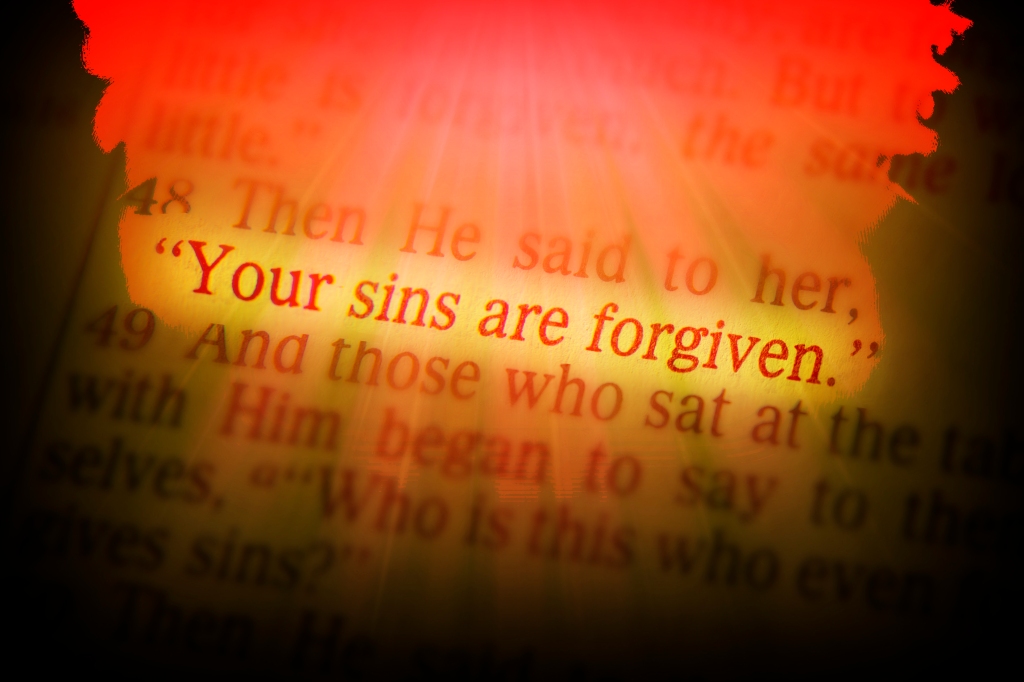
In my three Christian fiction series—Titus Ray Thrillers, Mylas Grey Mysteries, and Silas McKay Suspense—each of my protagonists is at a different place in his spiritual journey.
However, of the three, Titus Ray, a covert operative, has the most difficulty forgiving others for past mistakes.
Titus was brought to faith in Christ through the influence of an Iranian Christian couple in Tehran who hid him in their home for three months while he was on the run from the secret police.
Even though Titus grew up in “Christian” America, he knew nothing about Christianity. He came from a family who never attended church, who never mentioned God—except in a swear word—and who never went inside a church unless it was to attend a funeral.
Thus, it wasn’t surprising that Titus didn’t know how to live out his faith when he became a believer and returned to the States to resume his career at the CIA. However, he remembered the Iranian Christians read their Bible every day, so he purchased his first Bible and began reading the gospel of John.
From reading his Bible and being mentored by more mature believers, he gradually figured out how to control his volatile temper, and how to recognize the difference between deceiving others as part of his profession and doing so willfully to further his own agenda.
By far, the most difficult part of his Christian walk so far has been learning to forgive others—from his alcoholic father to other operatives who made foolish decisions that cost people their lives—but his journey toward real and lasting forgiveness only began when he heard these words from Ephesians 5:32: “And be kind to one another, tender-hearted, forgiving each other, just as God in Christ also has forgiven you.”
Jesus himself showed us the example when he was in the throes of agony on the cross and cried out, “Father, forgive them, for they know not what they do.” Luke 23:34.
Titus realized he was to forgive others even as he had been forgiven, for no one had ever wronged him as much as the Son of God had been wronged.
A lesson from a fictional character to real believers.
Fifteen Minutes Earlier

Whenever I come to the last day of a year, I always remember something that happened to me almost fifty years ago. That memory is triggered because at the end of every year, I finish reading all 66 books of the Bible.
Once I finish, I always record it in the front of the Bible I’ve been using for that year. Not surprisingly, I’ve gone through several Bibles in those fifty years.
Even though I write down each time I’ve read it through, I don’t do so to show I’ve met some goal. I do it to remind myself that I’ve kept my commitment to the Lord to spend the first fifteen minutes of every morning with Him.
In reality, I usually spend an hour reading the Bible and praying before I start my day, but when I first made this commitment, I only agreed to do it for fifteen minutes.
I made this promise as I was convalescing at my parents’ house while recovering from gallbladder surgery. That’s when I came across a little booklet in my mother’s collection of books that was entitled “Time Alone With God.”
Even though I would often read my Bible, it was sporadic and not a daily practice. However, this author challenged me to set my alarm fifteen minutes early and spend that time reading the Bible, using a plan included in the booklet that would mean I would read the Bible through in a year.
The author promised that if I would make this commitment, the Lord would meet me in the pages of His Word every morning, and I would come to know Him in a more intimate way.
There was a commitment page I could sign, along with the location of where I planned to have my “Time Alone With God.” Once I signed it, I noticed that below my signature, it said something like, “Remember this commitment, because the Lord will always be here waiting for you, whether you honor your promise or not.”
From that day forward, I’ve always set my alarm to get up in plenty of time to keep my commitment—despite obligations with my family and a work scheduled—and I’m convinced that having that time with the Lord has brought Him glory and honor and transformed my life into one of joy, peace, happiness, and contentment.
Tomorrow, January 1st (or a day of your choosing),you have the opportunity to experience this for yourself. I urge you to do so, and here’s a link where you can find a daily Bible reading plan to help you on your way.


Book 8 in the Mylas Grey Mystery Series, Click on cover

Book 5 in the Silas McKay Suspense Series, Click on cover

Book 11 in the Titus Ray Thriller Series. Click cover

Book 7 in the Mylas Grey Mystery Series on Amazon. Click cover.

Book 4 in the Silas McKay Suspense Series on Amazon. Click cover.

Book 10 in the Titus Ray Thriller Series on Amazon. Click cover.

PREQUEL to the Mylas Grey Mystery Series on Amazon. Click cover

Book VI in the Mylas Grey Mystery Series on Amazon. Click cover

Book III in the Silas McKay Suspense Series on Amazon. Click cover

Book IX in the Titus Ray Thriller Series on Amazon. Click cover

Book V in the Mylas Grey Mystery Series on Amazon. Click cover

Book II in the Silas McKay Suspense Series on Amazon. Click cover

Book I in the Silas McKay Suspense Series, Available in Winter Deceptions

Ben in Trouble follows Four Steps Missed in the Titus Ray Thriller Series

Book IV in the Mylas Grey Mystery Series on Amazon. Click cover

Book VIII in the Titus Ray Thriller Series on Amazon. Click cover.

Ben in Charge, Follows Three Steps Away in the Titus Ray Thriller Series

Ben in Love, Follows Two Steps Forward in the Titus Ray Thriller Series

Two Days Taken:Book II in the Mylas Grey Mystery Series; Click cover.

Book VII in the Titus Ray Thriller Series on Amazon. Click on book cover

One Day Gone: Book I in the Mylas Grey Mystery Series; Click on Cover

NEWEST BOOK: Available on Amazon. Click on Cover.

Prequel to the Titus Ray Thriller Series is $0.99 on Amazon. Click book cover


Book I in the Titus Ray Thriller Series on Amazon. Click book cover


Book II in the Titus Ray Thriller Series on Amazon. Click on book cover

Book III in the Titus Ray Thriller Series on Amazon: Click on book cover


Book IV in the Titus Ray Thriller Series on Amazon. Click on book cover.


Book V in the Titus Ray Thriller Series on Amazon. Click on book cover.


Book VI in the Titus Ray Thriller Series on Amazon. Click on book cover.


Books 1 & 2 in the Titus Ray Series Available on Amazon. Click on cover.


 His Glory My Joy, a blog of Author Luana Ehrlich
You must be logged in to post a comment.