Archive
Need A Blessing?

When a stranger suddenly sneezed when I was standing in front of her in the check out line at a grocery store, I responded by saying, “Bless you.”
She nodded and said, “Thank you. I needed a blessing.”
Her response amused me, and as I thought about this encounter later in the day, I was curious why we say, “God bless you,” or “Bless you,” when a person sneezes.
Naturally, that led me to do a little research on it, and I discovered this practice started during the Bubonic Plaque in Europe when sneezing was seen as a symptom of the disease. Saying, “God bless you,” was a way of asking God’s protection from the disease.
As believers in Christ, we don’t have to wait for a stranger to ask God’s blessings on us after a sneeze.
We can ask God to bless us at any time, at any place, and under any circumstance.
Matthew 7:7 tells us to “Ask, and it will be given to you; seek, and you will find; knock, and the door will be opened to you.”
An Old Testament character named Jabez asked for God’s blessing in this way: “Oh that you would bless me and enlarge my border, and that your hand might be with me, and that you would keep me from harm so that it might not bring me pain!” 1 Chronicles 4:9-10.
Before asking for God’s blessing, think of all the ways He’s already blessed you—salvation, family, career, shelter, health—and then be specific in the way you want Him to bless you now.
In asking for anything from the Lord, the Bible admonishes us to examine our motivation for asking—is it in keeping with God’s will for our life and the holy life he expects us to live as His children? How do we intend to use God’s blessing—for ourselves or for others?
One of the prayers of the Apostle Paul is a good guide to follow: “God, bless me abundantly, so that in all things at all times, having all that I need, I will abound in every good work.” 2 Corinthians 9:8.
My blessing for you today is this: “The Lord bless you and keep you; the Lord make his face shine on you and be gracious to you; the Lord turn his face toward you and give you peace.” Numbers 6:24-26.
Words Don’t Really Matter

Do words really matter? We tell our children they do. We defend our use of words. We remind ourselves to choose our words carefully.
However, at the end of our life, whether we die of old age, disease, violence, or an accident, our words don’t really matter. There’s only one word that matters—His Word—the Word of God.
It was His Word that brought our world into existence, His Word that brought comfort to sinful Man in the Garden, His Word that promised a coming redemption.
It was the Word who became a man, the Word who healed a cripple, the Word who restored sight to the blind, the Word who brought a dead man to life, the Word who said, “Father, forgive them.”
It was the Word who took the punishment for our sins, the Word who conquered death for us, the Word who rose to give us life.
Our words don’t really matter, but His Word does.
His Word says, “I am the way, and the truth, and the life. No one comes to the Father except through me.” John 14:7
No other words matter.
From Sin to Forgiveness
In my three Christian fiction series—Titus Ray Thrillers, Mylas Grey Mysteries, and Silas McKay Suspense—each of my protagonists is at a different place in his spiritual journey.
However, of the three, Titus Ray, a covert operative, has the most difficulty forgiving others for past mistakes.
Titus was brought to faith in Christ through the influence of an Iranian Christian couple in Tehran who hid him in their home for three months while he was on the run from the secret police.
Even though Titus grew up in “Christian” America, he knew nothing about Christianity. He came from a family who never attended church, who never mentioned God—except in a swear word—and who never went inside a church unless it was to attend a funeral.
Thus, it wasn’t surprising that Titus didn’t know how to live out his faith when he became a believer and returned to the States to resume his career at the CIA. However, he remembered the Iranian Christians read their Bible every day, so he purchased his first Bible and began reading the gospel of John.
From reading his Bible and being mentored by more mature believers, he gradually figured out how to control his volatile temper, and how to recognize the difference between deceiving others as part of his profession and doing so willfully to further his own agenda.
By far, the most difficult part of his Christian walk so far has been learning to forgive others—from his alcoholic father to other operatives who made foolish decisions that cost people their lives—but his journey toward real and lasting forgiveness only began when he heard these words from Ephesians 5:32: “And be kind to one another, tender-hearted, forgiving each other, just as God in Christ also has forgiven you.”
Jesus himself showed us the example when he was in the throes of agony on the cross and cried out, “Father, forgive them, for they know not what they do.” Luke 23:34.
Titus realized he was to forgive others even as he had been forgiven, for no one had ever wronged him as much as the Son of God had been wronged.
A lesson from a fictional character to real believers.
Comfort Food Needed

What’s your comfort food? My husband loves mashed potatoes and gravy. I love bread products. Oh, and chocolate, and maybe some cinnamon rolls thrown in too. And pizza! Don’t forget pizza.
But real comfort food can only be found in the Bible. Here are some of my favorites.
“Be strong, and let your heart take courage, all you who wait for the Lord!” Psalm 31:24.
“Our soul waits for the Lord; he is our help and our shield. For our heart is glad in him, because we trust in his holy name.” Psalm 33:20-21.
For the Lord your God is gracious and merciful and will not turn away his face from you, if you return to him.” 2 Chronicles 30:9.
Most of all, turn to the ONE who gives comfort.
“Blessed be the God and Father of our Lord Jesus Christ, the Father of mercies and God of all comfort.” 2 Corinthians 1:3
A Ready-Made Garden

As I was working in my garden this week, I kept reminding myself of how much I was going to love sitting on my patio this summer surrounded by thriving, flowering plants. I had to keep repeating this mantra because gardening is hard work.
In the midst of one of my many “rest periods,” I thought of the verse from Genesis 2:8, “And the Lord God planted a garden in Eden.” That sounded good to me, especially the part about God doing the planting. When Adam and Eve showed up in Eden, they had a ready-made garden, because God had already done all the heavy lifting for them.
This concept of God “serving” or “working” for His children is present throughout the Bible; yet, most believers are taught the opposite. That is, as followers of Christ, we are urged to find ways to serve Him. While it’s true we are to “serve the Lord with gladness” (Psalm 100:2), we are never to think our service toward God is anything He actually needs, that somehow He would be lacking something if we did not render Him our service.
In fact, when Paul was preaching to the Athenians, he tried to dissuade them from having such an attitude. He says in Acts 17:24-25, “The God who made the world and all things in it, since He is Lord of heaven and earth, does not dwell in temples made with hands; nor is He served by human hands, as though He needed anything, since He Himself gives to all people life and breath and all things.” God doesn’t need anything from us, because he is the Giver of all things; He is the self-sufficient One.
The proper response to our Giver is to receive His gifts with an abundantly grateful heart, acknowledging we have nothing to give in return. Peter tells us to serve “as one who serves by the strength that God supplies—in order that in everything God may be glorified through Jesus Christ.” (I Peter 4:11).
The service that glorifies God is service rendered through Him alone.
I Can Do Anything

I love the story of the little girl whose mother found her crying in the kitchen. When her mother asked her what was wrong, she said, “I’m in the kitchen, but I still don’t know how to cook.” Her mother put her up on a kitchen stool and proceeded to help her bake some cookies. Later, as they munched on the delicacies, the little girl observed, “If I let you do it, I can do anything.”
There are times when I’m standing in the middle of life, and I suddenly realize I don’t know how to do it. That’s when I try to remember to do these three things. By doing so, I feel as if I can do anything.
1. Ask God to take over.
Not long ago there was a popular song entitled “Jesus Take The Wheel.” It’s almost comical to think of Jesus of Nazareth in a long white robe and dusty sandals sitting in the driver’s seat and tooling along the highway of life with me in the passenger seat. However, while the picture may be amusing, the concept is theologically sound. John 16:33, “I have said these things to you, that in me you may have peace. In the world you will have tribulation. But take heart; I have overcome the world.” You can have peace; He’s overcome all the obstacles. Trust Him.
2. Allow others to help you.
It’s an all-American ideal to “make it on our own” or to “act independently,” but, that’s not a Biblical concept. When Paul speaks of believers in Christ, he describes each one as part of a whole. In fact, he sees this whole as if it were a human body. He says in 1 Corinthians 12:14, “the body is not one member, but many.” When I ask help from a fellow believer, I’m functioning in the way God intended His Spiritual body on earth to function.
3. Accept the personality God gave you.
Are you an introvert? Then don’t expect to live as an extrovert. Do you enjoy talking? Then don’t expect to stay silent. God says in Psalm 17, “You are the apple of my eye,” and in Isaiah 44:2, “This is what the LORD says– he who made you, who formed you in the womb, and who will help you:” Perhaps the best passage for understanding the hand of God upon the life of every individual is Psalm 139. The message in these verses is that God made you the way you are, and you glorify Him when you accept this truth.
Ask God.
Allow Others.
Accept Yourself.
Remember this pyramid with God at the pinnacle. “I can do all things through Christ who gives me strength.” Philippians 4:13.
The Being of “Not”

I’ve always been fascinated by what John the Baptist said when someone asked him if he was the long-awaited promised Messiah. “I am not the Messiah,” he said (John 1:20).
Why does his answer fascinate me?
First, since they asked him the question, some in the crowd obviously thought he might be the Messiah. The gospel writers don’t tell us whether it was his dress, his demeanor, or his preaching, but evidently some saw this as a possibility.
John could have claimed the title easily enough.
He had an extraordinary, miraculous birth. An angel appeared in person to his father to announce his birth. His mother had been unable to have children, and she was already past the age of bearing children when she got pregnant, plus his father lost his ability to speak throughout his wife’s pregnancy, and his voice only returned when John was born.
But John refused the title of Messiah, despite the fact it would have made him even more popular and more people would have been drawn to him to hear his message.
“I am not the Messiah.”
His answer also fascinates me because by knowing who he was not, John is also indicating he knows who he is. Although he is not the Messiah, he is someone with a message and a mission.
Luke 3:3 says, “And he went into all the region around the Jordan, proclaiming a baptism of repentance for the forgiveness of sins.”
In John’s declaration of “I am not the Messiah,” I find a powerful truth for how God calls me to live my own life. Knowing who I am not—whether it’s an age, a career, a family role, a ministry—is the key to knowing who I am.
No matter who I am not, God has given me a message and a mission, and like John, this message and mission will ultimately point away from me and to the true Messiah.
When John was baptizing one day, he saw Jesus walking along the banks of the Jordan River and he said to those around him, “Behold, the Lamb of God, who takes away the sin of the world!” (John 1:29).
I am not the Messiah, but I know the Messiah who has taken away the sins of the world.
You can know the Messiah too. Learn more here.
Finding Hidden Treasures

Don’t you love to find a word from the Lord in your Bible that you’ve never seen before? That happened to me just recently when I was reading the last verses in the little bitty book of Jude, so small it doesn’t even have any chapters.
The verses I hadn’t noticed before were verses 24-25 of . . . well, just Jude.
“Now to him who is able to keep you from stumbling and to present you blameless before the presence of his glory with great joy, to the only God, our Savior, through Jesus Christ our Lord, be glory, majesty, dominion, and authority before all time and now and forever. Amen.”
While there’s so much in these verses, I’ve highlighted three phrases that blessed me especially.
Present you blameless: I love being reminded when believers stand before his presence one day, we’ll be considered blameless. How great is that? And notice how it happens—through Jesus Christ our Lord.
With great joy: Notice the one doing the presenting of us before His presence will do so with great joy. He—Jesus—will be delighted to make everyone who believes in Him known to His Father. It will be His pleasure to do so. He even asked the Father in John 17 for this to happen. “Father, I desire that they also, whom you have given me, may be with me where I am, to see my glory.”
Before all time: Our God is an eternal God. There has never been a time when He didn’t exist. He was before all time, and He will go on forever through all time, even when time is no more. This is mind-boggling, hard to grasp, and yet, strangely reassuring.
There’s so much more in these two verses, and in the days ahead, I plan to give more thought to the treasures to be found there. I have a feeling I won’t be disappointed.
Happiness?

It’s been a couple of rainy days here in Oklahoma. Not much sunshine. I’m not a person given to depression, and I really like rainy days, but I still found myself longing for some sunshine.
People just seem to be happier when the sun is shining. As I thought about happiness, I remembered a devotional I’d read about mankind’s universal search for happiness.
In the article, this quote is referenced, “All that we call human history–money, poverty, ambition, war, prostitution, classes, empires, slavery–is the long terrible story of man trying to find something other than God which will make him happy.” –C.S. Lewis, Mere Christianity.
A bright cloudless day can’t really make a person happy. Only God can do that.
Turn your face toward the Son. Bask in the warmth and happiness of His Light today.
“You make known to me the path of life, in your presence there is fullness of joy; at your right hand are pleasures forevermore.” Psalm 16:11.
Lost Your Way?
 It’s easy to lose your way in our world today. We’re inundated with a myriad of messages, images, and ideas. How do we choose what to believe, what path to follow, how to live? We can explore all our options, saturating ourselves with philosophies, practices, and beliefs.
But, like hikers exploring a new trail, there are some precautions we should take before we head off into the unknown. Otherwise, we’re sure to lose our way. These practices should serve us well, whether we’re looking at a belief system, a political choice, a new set of friends, or exploring health issues, anything requiring our time, money, and effort.
First, FIND a way to have a Daily Quiet Time.
Spend at least thirty minutes every day in Bible study and prayer. It doesn’t matter how you do this. There’s a Bible reading plan out there that will match up with anyone’s learning style and preferences. The important thing is to put yourself in a position where your Father in heaven can communicate His love, His plan, and His desires for you, and you can catch a glimpse of His Glory each and every day.
Second, FIND a way to worship God in a group setting, even through media.
Praising, loving, and serving God with other people will strengthen and enhance your faith. It’s about gathering with like-minded people who desire to give glory, honor, and praise to an Almighty Creator who sacrificed His only son to make sure we spend eternity with Him.
Third, FIND a way to express your faith.
Our belief in God requires an outlet. Otherwise, stagnation sets in. This expression can take many forms, and it may be different according to personality types. For some, it may mean singing, speaking, teaching, or preaching. For others, it may mean journaling, writing, serving, or counseling.
Hear the words of the prophet Jeremiah in Jeremiah 6:16: “Thus says the Lord: Stand by the roads, and look, and ask for the ancient paths, where the good way is; and walk in it, and find rest for your souls.”
Rest for your soul as you find your way. What could be better than that?


Book 8 in the Mylas Grey Mystery Series, Click on cover

Book 5 in the Silas McKay Suspense Series, Click on cover

Book 11 in the Titus Ray Thriller Series. Click cover
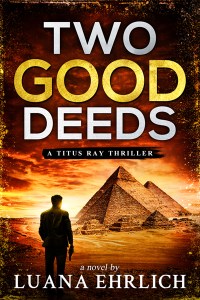
Book 7 in the Mylas Grey Mystery Series on Amazon. Click cover.

Book 4 in the Silas McKay Suspense Series on Amazon. Click cover.

Book 10 in the Titus Ray Thriller Series on Amazon. Click cover.

PREQUEL to the Mylas Grey Mystery Series on Amazon. Click cover

Book VI in the Mylas Grey Mystery Series on Amazon. Click cover

Book III in the Silas McKay Suspense Series on Amazon. Click cover

Book IX in the Titus Ray Thriller Series on Amazon. Click cover

Book V in the Mylas Grey Mystery Series on Amazon. Click cover

Book II in the Silas McKay Suspense Series on Amazon. Click cover

Book I in the Silas McKay Suspense Series, Available in Winter Deceptions

Ben in Trouble follows Four Steps Missed in the Titus Ray Thriller Series

Book IV in the Mylas Grey Mystery Series on Amazon. Click cover

Book VIII in the Titus Ray Thriller Series on Amazon. Click cover.

Ben in Charge, Follows Three Steps Away in the Titus Ray Thriller Series

Ben in Love, Follows Two Steps Forward in the Titus Ray Thriller Series

Two Days Taken:Book II in the Mylas Grey Mystery Series; Click cover.

Book VII in the Titus Ray Thriller Series on Amazon. Click on book cover

One Day Gone: Book I in the Mylas Grey Mystery Series; Click on Cover

NEWEST BOOK: Available on Amazon. Click on Cover.

Prequel to the Titus Ray Thriller Series is $0.99 on Amazon. Click book cover


Book I in the Titus Ray Thriller Series on Amazon. Click book cover


Book II in the Titus Ray Thriller Series on Amazon. Click on book cover

Book III in the Titus Ray Thriller Series on Amazon: Click on book cover


Book IV in the Titus Ray Thriller Series on Amazon. Click on book cover.


Book V in the Titus Ray Thriller Series on Amazon. Click on book cover.


Book VI in the Titus Ray Thriller Series on Amazon. Click on book cover.


Books 1 & 2 in the Titus Ray Series Available on Amazon. Click on cover.


 His Glory My Joy, a blog of Author Luana Ehrlich
You must be logged in to post a comment.