Archive
Getting A Little Personal
 There are so many ways to read the Bible. You can read it like great literature, read it for academic purposes, read it to understand a culture, read it to gain a sense of morality, or, of course, read it for a myriad of spiritual reasons—to know GOD, to know His Son, to know the working of His Spirit.
I’ve discovered the best way to read the Bible is to make it personal, to view the message of God’s Word as personal, and to understand the words as written for me—personally. How’s that for personal?
The Bible itself encourages this method of Bible study. David, speaking in Psalm 16:11, says, “You make known to me the paths of life.” David has a personal relationship with God. While it’s true the Bible has a message for all people, God intends for that message to be understood and received by each individual.
Although I read through the Bible every year, I always ask for new insight into how each day’s reading is speaking to me personally, what personal message God is intending for me in the verses, and in what way a particular Scripture can deepen my personal relationship with Him.
How personal can it get? Psalm 139 says it all.
O Lord, you have searched me and known me!
2 You know when I sit down and when I rise up;
you discern my thoughts from afar.
3 You search out my path and my lying down
and are acquainted with all my ways.
4 Even before a word is on my tongue,
behold, O Lord, you know it altogether.
5 You hem me in, behind and before,
and lay your hand upon me.
6 Such knowledge is too wonderful for me;
it is high; I cannot attain it.
7 Where shall I go from your Spirit?
Or where shall I flee from your presence?
8 If I ascend to heaven, you are there!
If I make my bed in Sheol, you are there!
9 If I take the wings of the morning
and dwell in the uttermost parts of the sea,
10 even there your hand shall lead me,
and your right hand shall hold me.
11 If I say, “Surely the darkness shall cover me,
and the light about me be night,”
12 even the darkness is not dark to you;
the night is bright as the day,
for darkness is as light with you.
13 For you formed my inward parts;
you knitted me together in my mother’s womb.
14 I praise you, for I am fearfully and wonderfully made.[a]
Wonderful are your works;
my soul knows it very well.
15 My frame was not hidden from you,
when I was being made in secret,
intricately woven in the depths of the earth.
16 Your eyes saw my unformed substance;
in your book were written, every one of them,
the days that were formed for me,
when as yet there was none of them.
17 How precious to me are your thoughts, O God!
How vast is the sum of them!
18 If I would count them, they are more than the sand.
I awake, and I am still with you.
For a great selection of various Bible Reading Plans, click here.
Waiting for the Blue Bar
 If you would have asked me the moment I made my commitment to Christ if I loved the Lord, I would have said yes.
Now though, as I look back on it, it’s hard to measure that kind of love.
That’s because I know more about Him now, so I feel I love Him more. My relationship with Him now, as compared to when I first came into a relationship with Him, makes that initial claim of loving him seem as nothing.
I was thinking about this one day as I sat in front of my computer watching a new program get downloaded. A pop-up box dominated the screen with a line of text assuring me the process of downloading was taking place. Even though I wasn’t able to see it, I was supposed to believe it was going on in the background.
To help me visualize the progress of the download, a long bar appeared in the pop-up box. The bar was clear with no color showing. Because I’d done this before, I knew the moment the software elements were added to my hard drive, the bar would begin to fill up with blue. The colorization would begin on the left side and gradually make its way over to the right, culminating in a solid blue bar. Once that happened, the download was complete, and I was encouraged to begin using my new program.
How this blue download bar related to my thoughts about my love for Christ is easy to describe but hard to explain.
Picture the clear bar as the moment I accepted Him as my Savior. Then, picture the bar as completely filled in at some future moment in eternity when I shall know Him fully and love Him perfectly.
In this comparison, what kind of progress can I see on the blue bar right now? Practically none. Perhaps a little sliver of blue on the far left-hand side. Nothing more.
However, like the message on the pop-up box, God’s Word is continually reassuring me my life is being changed and the elements of my sanctification are being added. Though I may not see any progress, I must believe the message.
One day, Jesus promises His believers they’ll hear, “Well done, good and faithful servant. You have been faithful over a little; I will set you over much. Enter into the joy of your master.” (Matthew 25:23).
One day, the download will be complete, and we’ll be able to use our new program.
In the meantime, be patient and keep reading His Word, His Message of Hope.
Oh, gross!
 Until recently, I never realized how gross the subject of purification could be. Then, I had to do some research about my refrigerator’s water filter, and I read about the stuff a water purifier is suppose to remove–things like cysts, radioactive particles, arsenic, bacteria, viruses, and chemicals.
I found myself getting a little sick just reading about the stuff.
The same week I was researching pure water, I read this from James 4:8, “Cleanse your hands, you sinners, and purify your hearts, you men of double mind.”
God expects those who desire His presence in their lives to have their hearts pure, to be free from contaminants. However, pure hearts, like pure water, must go through a purification process before being pronounced clean. Like water from a dirty lake, our hearts don’t become pure on their own. Hearts must be cleansed by an outside source.
David, in Psalm 51:10, cried out to God for purification, “Create in me a clean heart, O God!” Only when we cry out to God for purification does the process of heart cleansing truly begin. Luke, writing in Acts 15:9, says God does His act of purification “by faith.”
Water purification occurs when I connect a water filter to a water source. Heart purification occurs when, by faith, I connect my desire for purity with the source of purity, God Himself.
Matthew 5:8: “Blessed are the pure in heart, for they shall see God.”
What Are Your Credentials?
 Credibility. Politicians fake it. Pundits announce it. Actors crave it. Businesses sell it. However, when it comes right down to it, no one does credibility like God does credibility.
I was just about to finish up an interview with a book website about my Titus Ray Thriller series, when I was asked, “What are your credentials to write this series?” The question stumped me for a minute. Were they asking about my experience as a writer? Were they questioning my knowledge of the subject? Were they just wondering if I had enough creativity to write a series of books?
In the end, I answered the question by referring to the premise of the series and how my main character was growing in his faith while working as a covert operative. I decided not to make the case for my own credentials because, quite frankly, I wasn’t sure I could do that.
God, on the other hand, can always do that. He has the credibility. When God comes to the prophet Jeremiah to give him His message to the people of Israel in Jeremiah 33:2, He says, “Thus says the Lord who made the earth, the Lord who formed it to establish it—the Lord is his name.” On what basis does God come to the prophet? He comes as THE ONE who made the earth.
Those are pretty good credentials. In fact, they’re GLORIOUS. The God who created the world around us, the universe and all that’s in it, from the smallest particle to the biggest galaxy, is someone who has credentials. And this is what our God tells Jeremiah to do in Jeremiah 33:4: “Call to me and I will answer you, and will tell you great and hidden things that you have not known.”
With credentials like that, why wouldn’t we?
Are You Tired of Waiting?
 Not long ago, as I was dealing with some of my dad’s health issues, I spent several hours in various doctors’ offices, imaging centers, and hospitals. Most of my time in those places was spent in a waiting room.
During one long day, I found myself thinking about all the times I’ve been in God’s Waiting Room.
God’s Waiting Room is a place familiar to all praying believers. Those who petition the Father for answers, for relief, for deliverance, for guidance, and for comfort often find such requests are not answered immediately. That’s why God designed His Waiting Room.
If the waiting goes on for months, even years, God’s Waiting Room can become a place of discontentment, anger, frustration, and unbelief.
I know. It’s happened to me. Don’t let it happen to you.
I’ve learned that waiting on God doesn’t have to be unbearable as long as I follow the same basic principles I follow when waiting on a loved one in a hospital waiting room.
1. Don’t wait alone. Waiting is always easier if the wait is shared.
2. Find something to do while waiting. Occupying body, mind, and spirit makes the wait easier.
3. Encourage others as you wait. Empathy for others who may be going through similar circumstances lightens your burden and blesses your soul.
4. Recognize God has a sovereign purpose in the length of your wait. Waiting is no different from anything in your life—God is working all things for His Glory and your benefit.
Those willing to wait on God are given a special promise. It’s found in Isaiah 64:4: “No eye has seen a God like you, who works for those who wait for him.”
While you’re in God’s Waiting Room, He’s out there working for you.
Keep on waiting.
Don’t Put Up With It!
 For years, I’ve used a decorative paper towel holder in my kitchen. It looked nice; matched my kitchen theme—roosters—and held my roll of paper towels within arm’s reach.
There was one problem with the holder. It was made for an earlier time, when a roll of paper towels wasn’t as thick as it is today. That meant every time a new roll was placed on the horizontal pole, I had to use one hand to grab a towel and the other to pull it away from the roll and tear it off.
This was frustrating, because when I’m cooking, I don’t always have a free hand to grab a towel. Of course, the problem resolved itself once several towels were removed. Then, the roll would move freely on the holder. After that, I wouldn’t give it another thought.
The other day, I accidentally hit the bottom of the ceramic holder, and a piece of it fell off. I didn’t immediately think about replacing it, because it wasn’t that noticeable, and it didn’t affect the way it worked. Later that day, I was in a Bed, Bath, and Beyond store shopping for another product, and I happened to pass by a shelf of paper towel holders. Several of them had labels describing them as being perfect for today’s extra large rolls.
That was the moment I decided not to put up with the frustration I felt every time I inserted a new roll of paper towels on the ceramic holder, and I used my 20% off coupon and purchased a sleek new modern-looking one.
When I brought it home, I placed a fresh roll of paper towels on it, and presto! problem solved. I’ve had it a week now, and I’ve probably changed the roll three times—I’m very messy in the kitchen—and, every time I install a fresh roll, I ask myself why I didn’t buy a new paper towel holder sooner.
Why did I put up with something that was clearly a problem and had an easy solution?
The answer’s pretty simple. It seemed like a small problem, and I had too many other things to think about, and, after removing a few sheets, I didn’t notice it again until I needed a new roll.
Too often, we treat spiritual problems in the same way. A situation arises; tempers flare, angry words are spoken, lustful thoughts are entertained, gossip is spread, godless choices are made, and then we move on.
However, the sin that caused the problem in the first place remains; it’s never examined, never prayed over or confessed, and the situation happens again. And again.
God’s Word gives us much counsel about dealing with our sin, and one example is found in Psalm 51 where David realizes the only solution to the sorrow he’s experiencing is to confess his sin to God.
“Create in me a pure heart, O God, and renew a steadfast spirit within me. Do not cast me from your presence or take your Holy Spirit from me. Restore to me the joy of your salvation.” (Psalm 51:10-12).

Don’t put up with it!
Such Useless Things
 The other day I was standing beside an elevator, having just pushed the Arrow Down button to call the elevator up to the second floor, when an elderly gentleman walked over and pushed the same button again. Then, he turned to me and said, “I know that was useless. The elevator won’t get here any sooner just because two people push it.”
At the grocery store, a little later that day, I tried to sign my name on a credit card scanner. After several attempts to make a semi-legible mark, the clerk waved her hand at me and said, “Oh, honey, forget it. Your signature won’t mean anything on there. That thing is useless.”
My day of useless things ended when I got home and tried to balance my checkbook. No, it wasn’t balancing the checkbook that proved useless. What was useless was pushing the “C” repeatedly on the calculator, clearing out the old amount before adding a new one. Like the gentleman at the elevator, I suddenly realized pressing the “C” a second time was an exercise in futility. The screen always went blank the first time I pushed it.
There’s a fourth useless thing we may be guilty of as well. It’s forgetting to worship our Creator. God reminds us of this in Isaiah 45:7 when He says, “I form light and create darkness, I make well-being and create calamity, I am the Lord, who does all these things.”
Failure to acknowledge the God of the Universe, He who created light and darkness, who directs every aspect of our lives, is useless. In the same chapter in Isaiah, God says,” By myself I have sworn; from my mouth has gone out in righteousness a word that shall not return:‘To me every knee shall bow, every tongue shall swear allegiance.” (Isaiah 45:23).
Finding Happiness
 As I enjoyed an early morning quiet time on my patio recently, I became captivated by the play of light and dark, shadow and sunlight, across the foliage of my backyard. I had just been reading a devotional about mankind’s universal search for happiness. In the article, C. S. Lewis’ classic, Mere Christianity, is referenced, particularly this quote, “All that we call human history–money, poverty, ambition, war, prostitution, classes, empires, slavery–is the long terrible story of man trying to find something other than God which will make him happy.”
After reading this quote, I glanced up from my iPad and saw the patterns the early morning sun was drawing in my garden. Some flowers were in shadow, while others were in sunlight. The flowers highlighted by the sunlight looked “happier” than those flowers residing in the shadows. Why was that? Well, obviously, it was because the “happier” flowers were basking in the sun’s light, while those in the shadow were not receiving the sun’s full benefits..
Although I’m quite certain flowers do not experience human emotions, my garden’s shadows and sunlight illustrated the truth of my devotional reading. We all seek happiness, but as long as we remain in the shadows–substituting other people, pleasures, and pursuits for God in our lives–we will never be truly happy.
“You make known to me the path of life, in your presence there is fullness of joy; at your right hand are pleasures forevermore.” Psalm 16:11.
Turn your face toward the Son. Bask in the warmth of His Light today.
How’s This For A Name?
 Deciding what to name a child can be challenging. I’ve passed the stage of needing to think about naming babies. Instead, I’m faced with what to name a character in a book, and that too can prove challenging.
When a character enters a scene, the person’s name usually pops in my head at the same time. However, before accepting this moniker as the appropriate tag for the person, I do a little research just to make sure it isn’t the name of a celebrity or a politician or some other famous person.
I also want a villain’s name to sound . . . well . . . villainous, and a strong character to have a strong sounding name. Think “Rocky” and you get the picture.
The Bible is full of great names for both babies and characters. These are names that have been around for thousands of years, and have quite literally stood the test of time. But, there are many “one time use” names in the Bible as well.
For instance, in the book of Hosea, God instructs a prophet to name his daughter “No Mercy” (Hosea 1:6). The son who came later was named “Not My People” (Hosea 1:9). The Hebrew names Lo-ruhama and Lo-ammi never quite caught on as popular names for offspring, but those names portrayed the message God was endeavoring to send His people at that time.
In the book of Ruth, a widow named Naomi, who also lost two sons, decided she wanted to be called Bitter. The Hebrew word was mara, and she wanted her name changed to Mara because she said, “the Almighty has dealt bitterly with me” (Ruth 1:20).
If you wanted a name to reflect how God has dealt with you, what would you call yourself? Mine would be blessed. Just call me Blessed.
What You Are NOT
 During a recent interview about Titus Ray, the main character in my Christian fiction series, I was asked to describe some of his personality traits. By doing so, I came up with some attributes, which point out what Titus is not: He is not an extrovert. He is not a scholar. He is not a family man.
By pinpointing what a person is NOT, a picture emerges about what a person is. The apostle John does this in the Gospel of John. He says, “There was a man sent from God, whose name was John. He came as a witness, to bear witness about the light, that all might believe through him. He was not the light, but came to bear witness about the light.” John 1:6-8.
Perhaps the most important attribute about John the Baptist was what he was NOT. He wasn’t the Messiah; He wasn’t the Light; He wasn’t our Savior. He had to reiterate this several times during his ministry. Every time he did so, he was able to tell people who he really was. He was a witness sent to point people to the real Savior, Jesus Christ.
There are other examples in Scripture of what people were NOT: Joseph was not an adulterous slave boy. David was not an intimidated shepherd. Daniel was not a cowered exile. Paul was not a timid follower of Christ.
How would you answer this question, “What are you NOT?”
How you answer that question will enable you to see what you are. The NOT realization of what he was helped John to know his role. He wasn’t the Light, but he was to tell about the Light. Perhaps you’re NOT a Sunday School teacher, but you can be a Sunday School member. Perhaps you’re NOT a teacher of the Bible, but you can read the Bible. Perhaps you’re NOT a prayer warrior, but you can pray.
John was sent by God. “There was a man sent from God.” John 1:6.
John was sent by God to be who he was; not someone he was NOT. Discover who you are NOT, and you’ll discover who you are.


Book 8 in the Mylas Grey Mystery Series, Click on cover

Book 5 in the Silas McKay Suspense Series, Click on cover

Book 11 in the Titus Ray Thriller Series. Click cover
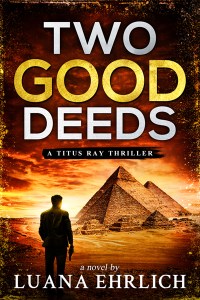
Book 7 in the Mylas Grey Mystery Series on Amazon. Click cover.

Book 4 in the Silas McKay Suspense Series on Amazon. Click cover.

Book 10 in the Titus Ray Thriller Series on Amazon. Click cover.

PREQUEL to the Mylas Grey Mystery Series on Amazon. Click cover

Book VI in the Mylas Grey Mystery Series on Amazon. Click cover

Book III in the Silas McKay Suspense Series on Amazon. Click cover

Book IX in the Titus Ray Thriller Series on Amazon. Click cover

Book V in the Mylas Grey Mystery Series on Amazon. Click cover

Book II in the Silas McKay Suspense Series on Amazon. Click cover

Book I in the Silas McKay Suspense Series, Available in Winter Deceptions

Ben in Trouble follows Four Steps Missed in the Titus Ray Thriller Series

Book IV in the Mylas Grey Mystery Series on Amazon. Click cover

Book VIII in the Titus Ray Thriller Series on Amazon. Click cover.

Ben in Charge, Follows Three Steps Away in the Titus Ray Thriller Series

Ben in Love, Follows Two Steps Forward in the Titus Ray Thriller Series

Two Days Taken:Book II in the Mylas Grey Mystery Series; Click cover.

Book VII in the Titus Ray Thriller Series on Amazon. Click on book cover

One Day Gone: Book I in the Mylas Grey Mystery Series; Click on Cover

NEWEST BOOK: Available on Amazon. Click on Cover.

Prequel to the Titus Ray Thriller Series is $0.99 on Amazon. Click book cover


Book I in the Titus Ray Thriller Series on Amazon. Click book cover


Book II in the Titus Ray Thriller Series on Amazon. Click on book cover

Book III in the Titus Ray Thriller Series on Amazon: Click on book cover


Book IV in the Titus Ray Thriller Series on Amazon. Click on book cover.


Book V in the Titus Ray Thriller Series on Amazon. Click on book cover.


Book VI in the Titus Ray Thriller Series on Amazon. Click on book cover.


Books 1 & 2 in the Titus Ray Series Available on Amazon. Click on cover.


 His Glory My Joy, a blog of Author Luana Ehrlich
You must be logged in to post a comment.