Archive
What’s Your Name?
 Deciding what to name a child can be challenging. While I’ve passed the stage of naming babies, today, I’m faced with what to name a character in a book. That too can prove challenging.
When a character enters a scene, the person’s name usually pops in my head at the same time. However, before accepting this moniker as the appropriate tag for the person, I do a little research just to make sure it isn’t the name of a celebrity or a politician or some other famous person.
I also want a villain’s name to sound . . . well . . . villainous, and a strong character to have a strong sounding name. Think “Rocky” and you get the picture.
The Bible is full of great names for both babies and characters. These are names that have been around for thousands of years, and have quite literally stood the test of time. But, there are many “one time use” names in the Bible as well.
For instance, in the book of Hosea, God instructs a prophet to name his daughter “No Mercy” (Hosea 1:6). The son who came later was named “Not My People” (Hosea 1:9). Their Hebrew names Lo-ruhama and Lo-ammi never quite caught on as popular names for offspring, but those names portrayed the message God was endeavoring to send His people at that time.
In the book of Ruth, a widow named Naomi, who had lost two sons, decided she wanted to be called Bitter. She wanted this name change because she said, “the Almighty has dealt bitterly with me” (Ruth 1:20).
If you wanted a name to reflect how God has dealt with you, what would you call yourself?
I would call myself Blessed. I pray it would be your name as well. We are all Blessed.
“Blessed is he whose help is the God of Jacob, whose hope is in the Lord his God.”
Psalm 146:5
Being Afraid of God
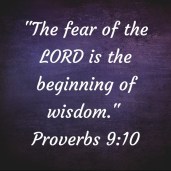 Be afraid. Be very afraid. Being afraid of God seems foreign to those of us who view God as the Lover of our Soul, who sing of His blessings, and who trust Him with our eternal soul.
Yet, one can’t read the Bible without encountering the oft-repeated admonition to “fear the Lord.” Throughout the Old Testament, there are numerous examples of God’s children receiving a blessing because they fear God. Also, because of fearing God, they do what He commands them to do. (Genesis 42:18; Exodus 1:17; Exodus 18:21)
Fear of God is not just an Old Testament concept, though. Jesus said in Matthew 10:28, “Don’t be afraid of those who want to kill your body; they cannot touch your soul. Fear only God, who can destroy both soul and body in hell.”
Nevertheless, there are times in my life when I’ve struggled with the concept of what it means to fear God. That’s why, when I recently came across a definition of fearing God in Drew Dyck’s book, Yawning At Tigers: You Can’t Tame God, So Stop Trying, I spent time meditating on it.
Dyck says, “To fear the Lord is to be grounded in reality, to have an accurate view of God’s holy nature and his awesome power.”
Fearing God doesn’t mean we cower in His presence—like a dog who knows he’s displeased his master—nor does it mean we run and hide instead of joyfully approaching Him. Instead, we embrace the fear of God because we recognize His to-be-feared characteristics, such as His all-powerful wrath toward sin, His unending sovereignty, and His unapproachable holiness, are an accurate understanding of who God really is.
The fearfulness of God is a reality, even if we don’t like it very much.
Having a true picture of God is the beginning of wisdom. Proverbs 9:10: “The fear of the LORD is the beginning of wisdom, and the knowledge of the Holy One is insight.”
We should fear God. We should be in awe of His wrath and His judgment. Yet, at the same time, we should have peace, knowing He is shielding us from wrath, sheltering us in His arms forever.
Seeing Light in Light
 I’m a very practical person, and I like for things to make sense, to be understandable, well-ordered. That’s why, whenever I’m reading the Bible and come across a verse that doesn’t make sense, it immediately gets my attention.
I read this verse in my Quiet Time this morning. Psalm 36:9, “For with you is the fountain of life; in your light do we see light.”
It was the last part of the verse that got my attention because, normally, when believers speak of seeing God or drawing closer to God or sensing the presence of God, there is an emphasis on the fact that it’s during the dark days, when God is most easily perceived.
However, like many aspects of living in God’s Kingdom, man’s way of thinking is reversed. Living in God’s Kingdom means “the first shall be last.” God says if you want to be great, “be a servant.” He admonishes believers to “repay evil with good” and “love your enemies.”
Thus, even though it’s true that the light of His Presence can sometimes be more easily seen when darkness envelops our world, the more we walk in His Light, the more we see His Light.
That’s because, as John writes in I John 1:5, “God is light, and in him there is no darkness at all,” so, the closer we walk toward the source of light, the brighter the light becomes.
Getting A Little Personal
 There are so many ways to read the Bible. You can read it like great literature, read it for academic purposes, read it to understand a culture, read it to gain a sense of morality, or, of course, read it for a myriad of spiritual reasons—to know GOD, to know His Son, to know the working of His Spirit.
I’ve discovered the best way to read the Bible is to make it personal, to view the message of God’s Word as personal, and to understand the words as written for me—personally. How’s that for personal?
The Bible itself encourages this method of Bible study. David, speaking in Psalm 16:11, says, “You make known to me the paths of life.” David has a personal relationship with God. While it’s true the Bible has a message for all people, God intends for that message to be understood and received by each individual.
Although I read through the Bible every year, I always ask for new insight into how each day’s reading is speaking to me personally, what personal message God is intending for me in the verses, and in what way a particular Scripture can deepen my personal relationship with Him.
How personal can it get? Psalm 139 says it all.
O Lord, you have searched me and known me!
2 You know when I sit down and when I rise up;
you discern my thoughts from afar.
3 You search out my path and my lying down
and are acquainted with all my ways.
4 Even before a word is on my tongue,
behold, O Lord, you know it altogether.
5 You hem me in, behind and before,
and lay your hand upon me.
6 Such knowledge is too wonderful for me;
it is high; I cannot attain it.
7 Where shall I go from your Spirit?
Or where shall I flee from your presence?
8 If I ascend to heaven, you are there!
If I make my bed in Sheol, you are there!
9 If I take the wings of the morning
and dwell in the uttermost parts of the sea,
10 even there your hand shall lead me,
and your right hand shall hold me.
11 If I say, “Surely the darkness shall cover me,
and the light about me be night,”
12 even the darkness is not dark to you;
the night is bright as the day,
for darkness is as light with you.
13 For you formed my inward parts;
you knitted me together in my mother’s womb.
14 I praise you, for I am fearfully and wonderfully made.[a]
Wonderful are your works;
my soul knows it very well.
15 My frame was not hidden from you,
when I was being made in secret,
intricately woven in the depths of the earth.
16 Your eyes saw my unformed substance;
in your book were written, every one of them,
the days that were formed for me,
when as yet there was none of them.
17 How precious to me are your thoughts, O God!
How vast is the sum of them!
18 If I would count them, they are more than the sand.
I awake, and I am still with you.
For a great selection of various Bible Reading Plans, click here.
Who I Am NOT
 During an interview about Titus Ray, the main character in my Christian fiction series, I was asked to describe some of his personality traits. Instead, I explained what Titus is NOT.
He is NOT an extrovert. He is NOT a gun guy. He is NOT a family man.
By pinpointing what a person is NOT, a picture emerges about what a person is.
The apostle John does this in the Gospel of John. He says, “There was a man sent from God, whose name was John. He came as a witness, to bear witness about the light, that all might believe through him. He was not the light, but came to bear witness about the light.” John 1:6-8.
Perhaps the most important attribute about John the Baptist was what he was NOT. He wasn’t the Messiah; He wasn’t the Light; He wasn’t our Savior. He had to reiterate this several times during his ministry. Every time he did so, he was able to tell people who he really was. He was a witness sent to point people to the real Savior, Jesus Christ.
There are other examples in Scripture of what people were NOT: Joseph was NOT an adulterous slave boy. David was NOT an intimidated shepherd. Daniel was NOT a cowered exile. Paul was NOT a timid follower of Christ.
How would you describe who you are NOT?
How you answer that question will enable you to see who you really are.
The NOT realization enabled John to know his role. He wasn’t the Light, but he was to tell about the Light.
Perhaps you are NOT a Sunday School teacher, but you can be a Sunday School member. Perhaps you are NOT a teacher of the Bible, but you can read the Bible. Perhaps you are NOT a prayer warrior, but you can pray.
“There was a man sent from God.” John 1:6. John was sent by God to be who he was; not someone he was NOT.
Discover who you are NOT, and you’ll discover who you are.
Afraid of God?
 The notion of being afraid of God seems foreign to those of us who view God as the Lover of our Soul, who sing of His blessings, and who trust Him with our eternal soul.
Yet, one can’t read the Bible without encountering the oft-repeated admonition to “fear the Lord.” Throughout the Old Testament, there are numerous examples of God’s children receiving a blessing because they fear God. Also, because of fearing God, they do what He commands them to do. (Genesis 42:18; Exodus 1:17; Exodus 18:21)
Fear of God is not just an Old Testament concept, though. Jesus said in Matthew 10:28, “Don’t be afraid of those who want to kill your body; they cannot touch your soul. Fear only God, who can destroy both soul and body in hell.”
Nevertheless, there are times in my life when I’ve struggled with the concept of what it means to fear God. That’s why, when I recently came across a definition of fearing God in Drew Dyck’s book, Yawning At Tigers: You Can’t Tame God, So Stop Trying, I spent time meditating on it.
Dyck says, “To fear the Lord is to be grounded in reality, to have an accurate view of God’s holy nature and his awesome power.”
Fearing God doesn’t mean we cower in His presence—like a dog who knows he’s displeased his master—nor does it mean we run and hide instead of joyfully approaching Him. Instead, we embrace the fear of God because we recognize His to-be-feared characteristics, such as His all-powerful wrath toward sin, His unending sovereignty, and His unapproachable holiness, are an accurate understanding of who God really is.
The fearfulness of God is a reality, even if we don’t like it very much.
Having a true picture of God is the beginning of wisdom. Proverbs 9:10: “The fear of the LORD is the beginning of wisdom, and the knowledge of the Holy One is insight.”
I live in Norman, Oklahoma. That means I know what’s it’s like to watch a mile-wide tornado approaching my city. It’s a fearful thing. However, if I’m hunkered down inside an indestructible storm shelter, I’m able to be in awe of the storm’s fierceness without fearing for my life.
We should fear God. We should be in awe of His wrath and His judgment. Yet, at the same time, we should have peace, knowing He is shielding us from wrath, sheltering us in His arms forever.
Life Out of Focus?
 One of the great things about most cameras today is the automatic focusing feature. I’m old enough to remember using a camera that required fiddling with a bunch of dials before snapping the picture. Most of the time, those waiting to be photographed weren’t very patient about this process, and, oftentimes, after all that effort, the photo turned out to be out of focus after all.
As children of God, it would be nice to have this automatic focusing mechanism built into our daily lives, so that the moment our lives became blurry around the edges—from taking part in all the world has to offer, from neglecting Bible study, from participating in non-glorifying activities—then our focus would automatically be returned to our Father and to living out Christ in us, “the hope of Glory” (Colossians 1:27).
However, none of us have an automatic focusing mechanism. What we have is something even better—the Word of God. While having a device to automatically redirect one’s focus towards God sounds good, in reality, such a device would ultimately lead to taking God for granted, and it would not adhere to the command to “work out your salvation with fear and trembling” (Philippians 2:12).
God’s Word directs us to focus on Him in numerous passages of Scripture throughout the Old and New Testament. One of my favorites is 2 Thessalonians 3:5: “May the Lord direct your hearts to the love of God and to the steadfastness of Christ.”
Have you lost your focus? Direct your heart today to the love of God. “The love of God was made manifest among us, that God sent his only Son into the world, so that we might live through him” (1 John 4:9).
Direct your heart to the steadfastness of Christ. “He who calls you is faithful; he will surely do it” (1 Thessalonians 5:24).
Spending time with the Lord in daily Bible study brings clarity to our lives and sharpens an otherwise blurry picture.
Lost Your Way?
 It’s easy to lose your way in the world. Our modern world has a myriad of paths from which to choose, and we can explore them all, saturating ourselves with facts and philosophies and desires and practices and beliefs.
However, like hikers exploring a new trail, there are some precautions we should take before we head off into the unknown. Otherwise, we’re sure to lose our way. These practices should serve us well, whether we’re looking at a belief system, a career choice, a new set of friends or anything requiring our time, money, and effort.
First, FIND a way to have a Daily Quiet Time
Spend at least thirty minutes every day in Bible study and prayer. It doesn’t matter how you do this. There’s a Bible reading plan out there that will match up with anyone’s learning style and preferences. The important thing is to put yourself in a position where your Father in heaven can communicate His love, His plan, and His desires for you, and in return, you can catch a glimpse of His Glory.
Second, FIND a way to meet with others to worship God
Praising, loving, and serving God with other people will strengthen and enhance an individual’s faith. However, being with others in a faith-based group isn’t always about the individual’s needs. It’s about a people who together desire to give glory, honor and praise to an Almighty Creator who sacrificed His only son to make such a relationship possible.
Third, FIND a way to express your faith
Our belief in God requires an outlet. Otherwise, stagnation sets in. This expression can take many forms, and it may be different according to personality types. For some, it may mean singing, speaking, teaching or preaching. For others, it may mean journaling, writing, serving, or counseling.
Jeremiah 6:16: “Thus says the Lord: Stand by the roads, and look, and ask for the ancient paths, where the good way is; and walk in it, and find rest for your souls.”
What In The World Is God Doing?
 Often, God’s work in our lives seems hidden, a barely discernible matter. That’s true in the life of an individual, the life of a church, and especially in the world itself. Yet, the Bible assures believers this is simply not the case. God is doing something in all areas of our life, our church, and the world. He’s doing it all the time.
So, what is God doing when we can’t see what He’s doing?
When God made His presence known to Moses through the flame shooting up from the non-burning bush, He told Moses what had been going on with Him while the children of Israel were suffering under the oppression of the Egyptian pharaoh. God said, “I have surely seen the affliction of my people who are in Egypt and have heard their cry because of their taskmasters. I know their sufferings” (Exodus 3:7).
That’s what God was doing then. That’s what God is doing now. He’s doing it in your life and He’s doing it in my life. He’s doing it throughout the world today.
God told Moses He “had surely seen.” Nothing escapes His attention. He sees it all. From the beheadings in the Middle East to the hairs on my head, not one thing gets past God. He’s observing every minutiae and every big thing.
God said He “had heard.” Not one word coming from my mouth escapes God’s ears. He hears my sweet words as well as my harsh words. He hears what your boss utters as well as what you utter about your boss. He hears words of profanity and words of praise. His ears are never closed; He hears it all.
“I know,” God said. God is aware, thoroughly knowledgeable, about me. That means He is completely cognizant of my every thought, my every motive, my every desire, my every sin, my every . . . my everything. This is true of a church body. This is true of a family, This is true of a nation. This is true of our universe.
When God told Moses what was going on with Him, He did so, not to instill fear, but to give Moses comfort. Moses was afraid of God, so God wanted to reassure Moses that the manifestation of His presence wasn’t to be feared. God described what He was up when He spoke from the midst of a flame in a non-burning bush. God did it again when He spoke in the form of His Son Jesus. “The Word became flesh and dwelt among us” (John 1:14).
We can be comforted by what’s going on with God both now and in the future. God not only told Moses what He was doing in the present, He also told Moses what He was about to do for His children. “I have come down to deliver them” (Exodus 3:8).
God will do the same for His children today. “Yes, I am coming soon” (Revelation 22:20).
Here’s A Little Secret For You!
 Everyone loves secrets. Whisper a secret to a child, and immediately his eyes light up. However, children don’t have a corner on the secrets market. Adults love to hear secrets almost as much as children love to tell them.
God has secrets—boy, does He have secrets! As if we didn’t know this already, the Bible tells us so.“The secret things belong to the Lord our God, but the things that are revealed belong to us and to our children forever, that we may do all the words of this law.” (Deuteronomy 29:29)
When God came in the flesh in the person of Jesus, He revealed His secrets in a form mankind had never seen before. John 1:18, “No one has ever seen God; the only God, who is at the Father’s side, he has made him known.”
Jesus revealed many secrets to his disciples. He even revealed explicit details about his upcoming death. Matthew 20:18-19, “We are going up to Jerusalem, and the Son of Man will be delivered over to the chief priests and the teachers of the law. They will condemn him to death and will hand him over to the Gentiles to be mocked and flogged and crucified. On the third day he will be raised to life!”
God even gave us a promise about His secrets: “For the Lord GOD does nothing without revealing his secret to his servants the prophets.” (Amos 3:7)
Every secret God wants us to know, He’s already revealed through his prophets. Just to make sure those of us living in this century would have access to those secrets, He had His prophets write them down.
So, you wanna know a secret? Just read His Word. There you’ll find the best-kept secrets!
{A longer version of this post was published in 2015. You can find it in the archives in April 2015}


Book 8 in the Mylas Grey Mystery Series, Click on cover

Book 5 in the Silas McKay Suspense Series, Click on cover

Book 11 in the Titus Ray Thriller Series. Click cover

Book 7 in the Mylas Grey Mystery Series on Amazon. Click cover.

Book 4 in the Silas McKay Suspense Series on Amazon. Click cover.

Book 10 in the Titus Ray Thriller Series on Amazon. Click cover.

PREQUEL to the Mylas Grey Mystery Series on Amazon. Click cover

Book VI in the Mylas Grey Mystery Series on Amazon. Click cover

Book III in the Silas McKay Suspense Series on Amazon. Click cover

Book IX in the Titus Ray Thriller Series on Amazon. Click cover

Book V in the Mylas Grey Mystery Series on Amazon. Click cover

Book II in the Silas McKay Suspense Series on Amazon. Click cover

Book I in the Silas McKay Suspense Series, Available in Winter Deceptions

Ben in Trouble follows Four Steps Missed in the Titus Ray Thriller Series

Book IV in the Mylas Grey Mystery Series on Amazon. Click cover

Book VIII in the Titus Ray Thriller Series on Amazon. Click cover.

Ben in Charge, Follows Three Steps Away in the Titus Ray Thriller Series

Ben in Love, Follows Two Steps Forward in the Titus Ray Thriller Series

Two Days Taken:Book II in the Mylas Grey Mystery Series; Click cover.

Book VII in the Titus Ray Thriller Series on Amazon. Click on book cover

One Day Gone: Book I in the Mylas Grey Mystery Series; Click on Cover

NEWEST BOOK: Available on Amazon. Click on Cover.

Prequel to the Titus Ray Thriller Series is $0.99 on Amazon. Click book cover


Book I in the Titus Ray Thriller Series on Amazon. Click book cover


Book II in the Titus Ray Thriller Series on Amazon. Click on book cover

Book III in the Titus Ray Thriller Series on Amazon: Click on book cover


Book IV in the Titus Ray Thriller Series on Amazon. Click on book cover.


Book V in the Titus Ray Thriller Series on Amazon. Click on book cover.


Book VI in the Titus Ray Thriller Series on Amazon. Click on book cover.


Books 1 & 2 in the Titus Ray Series Available on Amazon. Click on cover.


 His Glory My Joy, a blog of Author Luana Ehrlich
You must be logged in to post a comment.