The Being of “Not”

I’ve always been fascinated by what John the Baptist said when someone asked him if he was the long-awaited promised Messiah. “I am not the Messiah,” he said (John 1:20).
Why does his answer fascinate me?
First, since they asked him the question, some in the crowd obviously thought he might be the Messiah. The gospel writers don’t tell us whether it was his dress, his demeanor, or his preaching, but evidently some saw this as a possibility.
John could have claimed the title easily enough.
He had an extraordinary, miraculous birth. An angel appeared in person to his father to announce his birth. His mother had been unable to have children, and she was already past the age of bearing children when she got pregnant, plus his father lost his ability to speak throughout his wife’s pregnancy, and his voice only returned when John was born.
But John refused the title of Messiah, despite the fact it would have made him even more popular and more people would have been drawn to him to hear his message.
“I am not the Messiah.”
His answer also fascinates me because by knowing who he was not, John is also indicating he knows who he is. Although he is not the Messiah, he is someone with a message and a mission.
Luke 3:3 says, “And he went into all the region around the Jordan, proclaiming a baptism of repentance for the forgiveness of sins.”
In John’s declaration of “I am not the Messiah,” I find a powerful truth for how God calls me to live my own life. Knowing who I am not—whether it’s an age, a career, a family role, a ministry—is the key to knowing who I am.
No matter who I am not, God has given me a message and a mission, and like John, this message and mission will ultimately point away from me and to the true Messiah.
When John was baptizing one day, he saw Jesus walking along the banks of the Jordan River and he said to those around him, “Behold, the Lamb of God, who takes away the sin of the world!” (John 1:29).
I am not the Messiah, but I know the Messiah who has taken away the sins of the world.
You can know the Messiah too. Learn more here.
Do You Hear Voices?

Voices! We hear voices each and every day. Some are screaming at us from the TV, telling us to order this, pay attention to that, don’t forget this. Others are posting on our Facebook page, Twitter feed, other social media sites, wanting us to sign this, like that, look at this.
Who merits our attention? To whom should we be listening? Whose voice is the worthy voice?
A crippled up old man appears in the gospel of John to answer these questions. (John 5:1-17). He doesn’t have a name in the gospel, but everyone at the pool of Bethesda knew him. He had been lying there for thirty-eight years, unable to take advantage of the pool’s healing properties. Jesus stopped by one day, and, in one instantaneous moment, took care of the crippled man’s lifelong problem.
Following Jesus’ instructions, the Man Made Whole gathered up his bedroll and walked away. Later, when asked by the religious leaders what he thought he was doing carrying his bed around on a Sabbath, he told them he was doing what he’d been instructed to do by the man who had enough authority to make him whole again.
The Man Made Whole was carrying his bed—in defiance of the religious authorities—because he recognized a man who was able to give life to his withered limbs was someone with authority, someone worthy of his attention.
This same man, Jesus of Nazareth, healed me one day.
He healed me of a lifelong sin problem, a sickness so severe I was doomed for eternal destruction. He did so by taking sin’s disease on Himself and paying the price for it Himself. Now, he commands me to take up my life and live it for Him.
His voice is a voice worth hearing.
Listen to His words from the rest of John 5, “Truly, truly, I say to you, an hour is coming, and is now here, when the dead will hear the voice of the Son of God, and those who hear will live. For as the Father has life in himself, so he has granted the Son also to have life in himself.” (25-26)
Begin Anew

Goodbye, 2020!
January 1st is a day of HOPE. To many, it holds the enticing thought of a brand new start, a day to wipe the slate clean, to begin anew.
- We hope to lose weight, get more sleep, eat healthy.
- We hope to be more productive, get organized.
- We hope to get a better job, earn more money.
But, so much of what we hope for tomorrow will just be wishful thinking.
There’s a different kind of hope that’s not just wishful thinking. It’s a hope centered on Christ, a confidence that what God has promised He’ll bring to pass. I like to think of hope as the future tense of faith.
How can we have this hope that’s not just wishful thinking? Romans 10:17 says, “Faith comes by hearing and hearing by the Word of God.” It’s the Word of God that makes faith and hope possible.
All of your days in 2021 can be A Day of Hope by reading God’s Word.
Check out these Daily Bible Reading Plans for hope-filled days in 2021.
An Indescribable Gift!
 Every year, I give what I call my “Reason for the Season” gift.
It’s a present to remind each recipient of why we celebrate Christmas in the first place. My “Reason for the Season” gifts are never very elaborate. Most of them are simply stocking stuffers and cost very little.
These gifts can be as simple as a bookmark with a Scripture on it or a key chain with a Christian symbol swinging from it. During past Christmases, I’ve given a calendar or a devotional book. For children, I’ve put Veggie Tale toys and Bible story DVD’s under the tree. I’ve also given mugs and ornamental plaques with Scriptures on them.
I started this practice several years ago when my daughter was a teenager, and I suddenly realized the true meaning of God’s “gifting” us with His Son was being lost in the hustle and bustle of checking things off her Christmas wish list. Now, purchasing these “Reason for the Season” items from a Christian bookstore a few weeks before the big holiday seems to take the edge off the Christmas rush and serves as a reminder of the purpose of this celebration.
Truly, the “Reason for the Season” is a tiny helpless baby sent by a powerful, holy God to rescue a hopeless fallen sinner.
“Thanks be to God for His indescribable gift.” 2 Corinthians 2:15:
Finding Hidden Treasures

Don’t you love to find a word from the Lord in your Bible that you’ve never seen before? That happened to me just recently when I was reading the last verses in the little bitty book of Jude, so small it doesn’t even have any chapters.
The verses I hadn’t noticed before were verses 24-25 of . . . well, just Jude.
“Now to him who is able to keep you from stumbling and to present you blameless before the presence of his glory with great joy, to the only God, our Savior, through Jesus Christ our Lord, be glory, majesty, dominion, and authority before all time and now and forever. Amen.”
While there’s so much in these verses, I’ve highlighted three phrases that blessed me especially.
Present you blameless: I love being reminded when believers stand before his presence one day, we’ll be considered blameless. How great is that? And notice how it happens—through Jesus Christ our Lord.
With great joy: Notice the one doing the presenting of us before His presence will do so with great joy. He—Jesus—will be delighted to make everyone who believes in Him known to His Father. It will be His pleasure to do so. He even asked the Father in John 17 for this to happen. “Father, I desire that they also, whom you have given me, may be with me where I am, to see my glory.”
Before all time: Our God is an eternal God. There has never been a time when He didn’t exist. He was before all time, and He will go on forever through all time, even when time is no more. This is mind-boggling, hard to grasp, and yet, strangely reassuring.
There’s so much more in these two verses, and in the days ahead, I plan to give more thought to the treasures to be found there. I have a feeling I won’t be disappointed.
What a Surprise!

God reveals Himself in Scripture as a God who loves surprises. Throughout the Old Testament, God manifests Himself in surprising ways, He chooses surprising people, He acts in surprising circumstances.
God Manifests Himself in Surprising Ways:
- A burning bush
- A whirlwind
- A bunch of dry bones
- A barren womb
God Chooses Surprising People:
- An idol worshiper
- A murderer
- A con man
- A shepherd boy
- A prostitute
God Acts in Surprising Circumstances:
- A Flood
- A Battlefield
- A Famine
- A Murder
In the New Testament, God Himself becomes the surprise. From His birth announcement, His earthly life, His horrible death, and His anticipated return, it’s one surprise after another.
His Birth Announcement Surprised:
- His mother Mary
- His father Joseph
- The shepherds
- King Herod
His Earthly Life Brought Surprising:
- Miracles
- Teachings
- Revelations
His Horrible Death Surprised:
- The Disciples
- The Unbelievers
- The Roman Soldiers
His Anticipated Return Will Surprise:
- The Unprepared
- The Uninformed
- The Unbeliever
How will God surprise you? It could be a way in the wilderness or a river in the desert. “Behold, I am doing a new thing; now it springs forth, do you not perceive it? I will make a way in the wilderness and rivers in the desert.” Isaiah 43:19.
God will surprise you. Anticipate it. Look for it. Embrace it.
Happiness?

It’s been a couple of rainy days here in Oklahoma. Not much sunshine. I’m not a person given to depression, and I really like rainy days, but I still found myself longing for some sunshine.
People just seem to be happier when the sun is shining. As I thought about happiness, I remembered a devotional I’d read about mankind’s universal search for happiness.
In the article, this quote is referenced, “All that we call human history–money, poverty, ambition, war, prostitution, classes, empires, slavery–is the long terrible story of man trying to find something other than God which will make him happy.” –C.S. Lewis, Mere Christianity.
A bright cloudless day can’t really make a person happy. Only God can do that.
Turn your face toward the Son. Bask in the warmth and happiness of His Light today.
“You make known to me the path of life, in your presence there is fullness of joy; at your right hand are pleasures forevermore.” Psalm 16:11.
Lost Your Way?
 It’s easy to lose your way in our world today. We’re inundated with a myriad of messages, images, and ideas. How do we choose what to believe, what path to follow, how to live? We can explore all our options, saturating ourselves with philosophies, practices, and beliefs.
But, like hikers exploring a new trail, there are some precautions we should take before we head off into the unknown. Otherwise, we’re sure to lose our way. These practices should serve us well, whether we’re looking at a belief system, a political choice, a new set of friends, or exploring health issues, anything requiring our time, money, and effort.
First, FIND a way to have a Daily Quiet Time.
Spend at least thirty minutes every day in Bible study and prayer. It doesn’t matter how you do this. There’s a Bible reading plan out there that will match up with anyone’s learning style and preferences. The important thing is to put yourself in a position where your Father in heaven can communicate His love, His plan, and His desires for you, and you can catch a glimpse of His Glory each and every day.
Second, FIND a way to worship God in a group setting, even through media.
Praising, loving, and serving God with other people will strengthen and enhance your faith. It’s about gathering with like-minded people who desire to give glory, honor, and praise to an Almighty Creator who sacrificed His only son to make sure we spend eternity with Him.
Third, FIND a way to express your faith.
Our belief in God requires an outlet. Otherwise, stagnation sets in. This expression can take many forms, and it may be different according to personality types. For some, it may mean singing, speaking, teaching, or preaching. For others, it may mean journaling, writing, serving, or counseling.
Hear the words of the prophet Jeremiah in Jeremiah 6:16: “Thus says the Lord: Stand by the roads, and look, and ask for the ancient paths, where the good way is; and walk in it, and find rest for your souls.”
Rest for your soul as you find your way. What could be better than that?
God Loves You
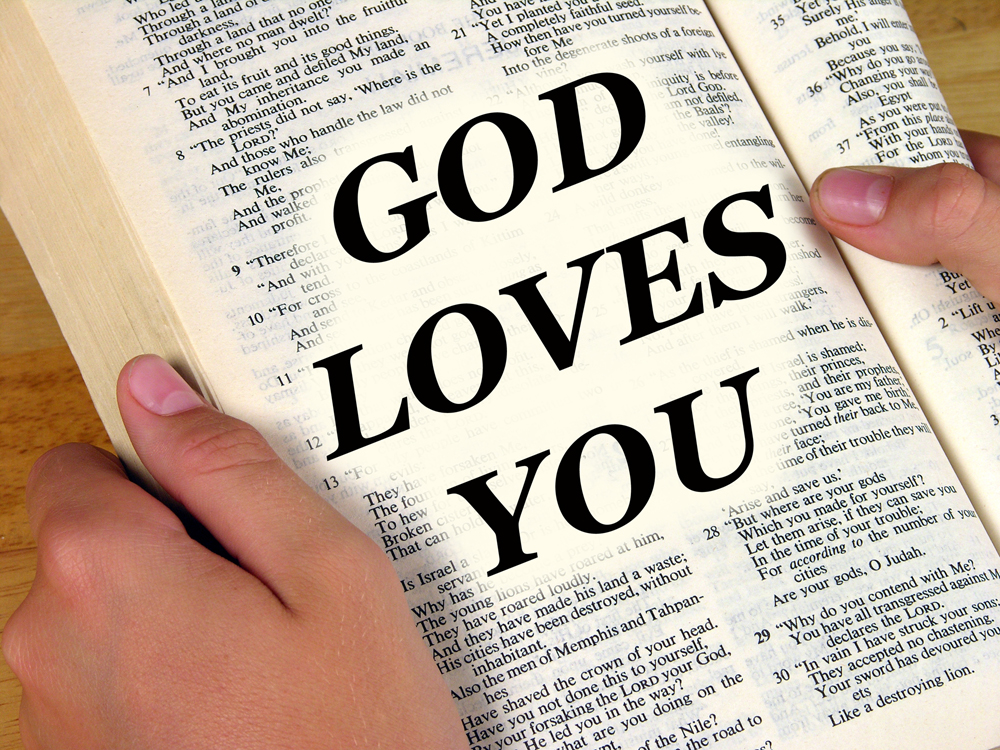 The words, “I don’t love you,” have to be the most hurtful words ever spoken. As human beings, we are born with the desire to be loved. Whether it’s romantic love, family love, brotherly love or even self love, God gave us the desire to be loved and to love God, others, and ourselves.
Love comes from God. “Dear friends, let us love one another, for love comes from God.” (1 John 4:7).
Because human love is so flawed by sin, none of us can ever love ourselves or another human being perfectly. In the same way, until we receive our glorified, perfected bodies, we can’t love God perfectly.
God has no such hindrances. He loves perfectly. On three different occasions, the prophet Daniel was told by the angel Gabriel that he was greatly loved by God. “I have come to tell it to you, for you are greatly loved.” (Daniel 9:23). The same thought is expressed in Daniel 10: 11 and Daniel 10:19.
How sweet those words must have sounded to Daniel! How would you like to hear those words for yourself? Well, you can.
Paul says in Ephesians 2:4-5: “God, being rich in mercy, because of the great love with which he loved us, even when we were dead in our trespasses,made us alive together with Christ.”
God’s love is on display for us in Romans 5:8.“But God shows his love for us in that while we were still sinners, Christ died for us.”
Like Daniel, God sent word to us that we are greatly love. He sent His Word in the form of His Son who demonstrated how much he really loved us by paying the penalty for our sins by His death on the cross
Accept His love. Bask in His Love. Know His love for all eternity.
Four Things I Pray
 Sometimes, I get so caught up in praying for the needs of others, I fail to pray for myself.
I was reminded of this during my quiet time, when I got to I Chronicles in my daily Bible reading.
In the margin of my Bible, I saw a previous note I’d written when I’d read the passage before—I’ve been reading the O.T. once a year and the N.T. twice a year for many years now—and I realized I’d gotten away from praying these four things for myself.
I pray the Lord will Bless, Prosper, Guide, and Protect me.
Bless Me—spiritually, physically, and mentally.
Prosper Me—spiritually, personally, and financially.
Guide Me—spiritually, intellectually, and creatively
Protect Me—spiritually, physically, intellectually, and financially.
The common thread is that I’m always praying for myself spiritually. If the Lord will bless, prosper, guide, and protect me spiritually, everything else will fall into place.
The Biblical basis for my prayer is found in I Chronicles 4:10: ” . . . Oh that you would bless me and enlarge my border, and that your hand might be with me, and that you would keep me from harm . . .”


Book 6 in the Silas McKay Suspense Series; Click on Cover

Book 12 in the Titus Ray Thriller Series Click on cover
Book 8 in the Mylas Grey Mystery Series, Click on cover

Book 5 in the Silas McKay Suspense Series, Click on cover

Book 11 in the Titus Ray Thriller Series. Click cover
Book 7 in the Mylas Grey Mystery Series on Amazon. Click cover.

Book 4 in the Silas McKay Suspense Series on Amazon. Click cover.

Book 10 in the Titus Ray Thriller Series on Amazon. Click cover.

PREQUEL to the Mylas Grey Mystery Series on Amazon. Click cover

Book VI in the Mylas Grey Mystery Series on Amazon. Click cover

Book III in the Silas McKay Suspense Series on Amazon. Click cover

Book IX in the Titus Ray Thriller Series on Amazon. Click cover

Book V in the Mylas Grey Mystery Series on Amazon. Click cover

Book II in the Silas McKay Suspense Series on Amazon. Click cover

Book I in the Silas McKay Suspense Series on Amazon. Click here

Ben in Trouble follows Four Steps Missed in the Titus Ray Thriller Series

Book IV in the Mylas Grey Mystery Series on Amazon. Click cover

Book VIII in the Titus Ray Thriller Series on Amazon. Click cover.

Ben in Charge, Follows Three Steps Away in the Titus Ray Thriller Series

Ben in Love, Follows Two Steps Forward in the Titus Ray Thriller Series

Two Days Taken:Book II in the Mylas Grey Mystery Series; Click cover.

Book VII in the Titus Ray Thriller Series on Amazon. Click on book cover

One Day Gone: Book I in the Mylas Grey Mystery Series; Click on Cover

Three Days Clueless, Book 3 in the Mylas Grey Mystery Series. Click on Cover.


You must be logged in to post a comment.