By His Stripes We Are Healed

of black and blue and red
of gashes and slashes and stripes
of hits and harm and hurt
He stumbles and bows and falls
He crumbles and bends and kneels
He gasps and cries and moans
for healing and helping and teaching
for blessing and loving and keeping
for hoping and holding and saving
Isaiah 54:4-5
A Devotional Poem by Luana Ehrlich
This Might Work!
 As I continually seek to be a student and teacher of God’s Word, I encounter many different methods, programs, and suggestions about how I should memorize, use, remember, and put into practice what I’ve studied and taught, and it usually doesn’t take me very long to recognize if something will work for me or not.
More often than not, I find myself thinking, “I will never do this” or “I can’t even begin to understand how this would work.” However, here are three helpful suggestions I’ve come across that made me say, “This might work!”
How To Talk To God: In this blog, Lisa gives some pointers about using God’s Word to talk to Him. What happens when you speak God’s own words back to Him? Find out here.
How To Walk By The Spirit: In this sermon from John Piper on 1 Thessalonians 3, you’ll find a wonderful acronym called APTAT, which you can use to remember what to do when asked to do something you don’t believe you can do. Piper ‘s message is entitled “The Word Of God Is At Work In You,” and the application of this (which is about 30 minutes into the video if you want to watch it) is outlined in the written sermon called Applying The Text To Your Life. Watch the video or read the sermon here.
How To View The Bible: Along with many of you, I am reading the Bible through again this year. In my plan I’m about to finish up Genesis, and I’ve seen the grace of God at every turn, from the moment of creation to God’s dealings with Joseph. But this will not be the end of God’s grace. In fact, the grace of God can be found in every book of the Bible. Dane Ortlund outlines how every book of the Bible shows God’s grace. You can read it here.
Maybe these suggestions will make you say, “This might work!”
2 Timothy 2:15: “Do your best to present yourself to God as one approved, a worker who has no need to be ashamed, rightly handling the word of truth.”
Being Afraid of God
 Be afraid. Be very afraid. Being afraid of God seems foreign to those of us who view God as the Lover of our Soul, who sing of His blessings, and who trust Him with our eternal soul.
Yet, one can’t read the Bible without encountering the oft-repeated admonition to “fear the Lord.” Throughout the Old Testament, there are numerous examples of God’s children receiving a blessing because they fear God. Also, because of fearing God, they do what He commands them to do. (Genesis 42:18; Exodus 1:17; Exodus 18:21)
Fear of God is not just an Old Testament concept, though. Jesus said in Matthew 10:28, “Don’t be afraid of those who want to kill your body; they cannot touch your soul. Fear only God, who can destroy both soul and body in hell.”
Nevertheless, there are times in my life when I’ve struggled with the concept of what it means to fear God. That’s why, when I recently came across a definition of fearing God in Drew Dyck’s book, Yawning At Tigers: You Can’t Tame God, So Stop Trying, I spent time meditating on it.
Dyck says, “To fear the Lord is to be grounded in reality, to have an accurate view of God’s holy nature and his awesome power.”
Fearing God doesn’t mean we cower in His presence—like a dog who knows he’s displeased his master—nor does it mean we run and hide instead of joyfully approaching Him. Instead, we embrace the fear of God because we recognize His to-be-feared characteristics, such as His all-powerful wrath toward sin, His unending sovereignty, and His unapproachable holiness, are an accurate understanding of who God really is.
The fearfulness of God is a reality, even if we don’t like it very much.
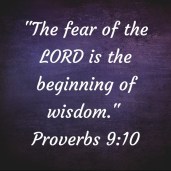
Having a true picture of God is the beginning of wisdom. Proverbs 9:10: “The fear of the LORD is the beginning of wisdom, and the knowledge of the Holy One is insight.”
We should fear God. We should be in awe of His wrath and His judgment. Yet, at the same time, we should have peace, knowing He is shielding us from wrath, sheltering us in His arms forever.
 Goodbye, 2018. Hello, 2019.
I’m Not A Messy Person
 I’m not a messy person. Seeing things in disarray and disorganized makes me uneasy. For my own peace of mind, I like to have things organized and in order. The only exception to this rule took place a few years ago when I made Christmas cookies with one of my grandsons.
After getting flour out of my hair, sweeping away the sugary sprinkles from the table and scrubbing icing off the kitchen floor, I asked myself what felt so right about the “messiness” of this activity.
I realized it was the joy of the end result—seeing everyone savoring their favorite Christmas cookie, whether it was the blue snowman with white eyes or the sprinkle-laden gingerbread man with the missing arm. I don’t mind this experience because there was a glorious conclusion.
Christmas can be seen as a “messy” time of year.
As we experience the never-ending hawking of merchandise, the stress of buying and finding gifts for family and friends, or the exhaustion of shopping, traveling, and decorating, we may feel uneasy and disoriented. Yet, I have to believe during that first Christmas, as Mary and Joseph awaited the birth of their little boy, their lives must have been in total disarray.
They were exhausted after an arduous journey, stranded in a dingy stable, forced to share some hay with a bunch of smelling animals while Mary labored in the pain of childbirth.
Did they enjoy that first Christmas? I have no doubt it was the most enjoyable moment of their lives. God had come to earth as Mary and Joseph’s little boy. The messiness of that stable didn’t matter. The glorious conclusion was the Joy Of Heaven come to earth.
It’s what makes the “messiness” of Christmas worthwhile. It’s Emmanuel, “God with us.”
Enjoy Christmas. God is with you and in you and for you.
“She will give birth to a son and will call him Immanuel.” Isaiah 7:14.
Seeing Light in Light
 I’m a very practical person, and I like for things to make sense, to be understandable, well-ordered. That’s why, whenever I’m reading the Bible and come across a verse that doesn’t make sense, it immediately gets my attention.
I read this verse in my Quiet Time this morning. Psalm 36:9, “For with you is the fountain of life; in your light do we see light.”
It was the last part of the verse that got my attention because, normally, when believers speak of seeing God or drawing closer to God or sensing the presence of God, there is an emphasis on the fact that it’s during the dark days, when God is most easily perceived.
However, like many aspects of living in God’s Kingdom, man’s way of thinking is reversed. Living in God’s Kingdom means “the first shall be last.” God says if you want to be great, “be a servant.” He admonishes believers to “repay evil with good” and “love your enemies.”
Thus, even though it’s true that the light of His Presence can sometimes be more easily seen when darkness envelops our world, the more we walk in His Light, the more we see His Light.
That’s because, as John writes in I John 1:5, “God is light, and in him there is no darkness at all,” so, the closer we walk toward the source of light, the brighter the light becomes.
Could I Have Your Attention, Please?
 Voices! We hear voices each and every day. They tell us to order this, pay attention to that, go there, come here.
Other voices post on our Facebook page, our Twitter feed, our social media sites, wanting us to sign this, like that, watch that, play this.
Who merits our attention? Whose voice is the worthy voice?
A crippled old man appears in the gospel of John to answer these questions. (John 5:1-17).
He doesn’t have a name in the gospel, but everyone at the pool of Bethesda knew him. He’d been lying there for thirty-eight years, unable to take advantage of the pool’s healing properties. Then, Jesus stopped by one day, and, in one instantaneous moment, He took care of the crippled man’s lifelong problem.
Following Jesus’ instructions, the Man Made Whole gathered up his bedroll and walked away. Later, when asked by the religious leaders what he thought he was doing carrying around his bed on a Sabbath, he told them he was doing what he’d been instructed to do by the man who’d healed him, by the man who had enough authority to make him whole again.
The Man Made Whole was carrying his bed—in defiance of the religious authorities—because he recognized someone who was able to give life to his withered limbs was someone with authority, someone worthy of his attention.
This same man, this Jesus of Nazareth, healed me one day. He healed me of a lifelong sin problem, a sickness so severe I was doomed for eternal destruction. He did so by taking sin’s disease on Himself and paying the price for it Himself. Now, he commands me to take up my life and live it for Him.
His voice is a voice worth hearing.
Listen to His words from the rest of John 5, “Truly, truly, I say to you, an hour is coming, and is now here, when the dead will hear the voice of the Son of God, and those who hear will live. For as the Father has life in himself, so he has granted the Son also to have life in himself.” (25-26)
Getting A Little Personal
 There are so many ways to read the Bible. You can read it like great literature, read it for academic purposes, read it to understand a culture, read it to gain a sense of morality, or, of course, read it for a myriad of spiritual reasons—to know GOD, to know His Son, to know the working of His Spirit.
I’ve discovered the best way to read the Bible is to make it personal, to view the message of God’s Word as personal, and to understand the words as written for me—personally. How’s that for personal?
The Bible itself encourages this method of Bible study. David, speaking in Psalm 16:11, says, “You make known to me the paths of life.” David has a personal relationship with God. While it’s true the Bible has a message for all people, God intends for that message to be understood and received by each individual.
Although I read through the Bible every year, I always ask for new insight into how each day’s reading is speaking to me personally, what personal message God is intending for me in the verses, and in what way a particular Scripture can deepen my personal relationship with Him.
How personal can it get? Psalm 139 says it all.
O Lord, you have searched me and known me!
2 You know when I sit down and when I rise up;
you discern my thoughts from afar.
3 You search out my path and my lying down
and are acquainted with all my ways.
4 Even before a word is on my tongue,
behold, O Lord, you know it altogether.
5 You hem me in, behind and before,
and lay your hand upon me.
6 Such knowledge is too wonderful for me;
it is high; I cannot attain it.
7 Where shall I go from your Spirit?
Or where shall I flee from your presence?
8 If I ascend to heaven, you are there!
If I make my bed in Sheol, you are there!
9 If I take the wings of the morning
and dwell in the uttermost parts of the sea,
10 even there your hand shall lead me,
and your right hand shall hold me.
11 If I say, “Surely the darkness shall cover me,
and the light about me be night,”
12 even the darkness is not dark to you;
the night is bright as the day,
for darkness is as light with you.
13 For you formed my inward parts;
you knitted me together in my mother’s womb.
14 I praise you, for I am fearfully and wonderfully made.[a]
Wonderful are your works;
my soul knows it very well.
15 My frame was not hidden from you,
when I was being made in secret,
intricately woven in the depths of the earth.
16 Your eyes saw my unformed substance;
in your book were written, every one of them,
the days that were formed for me,
when as yet there was none of them.
17 How precious to me are your thoughts, O God!
How vast is the sum of them!
18 If I would count them, they are more than the sand.
I awake, and I am still with you.
For a great selection of various Bible Reading Plans, click here.
Don’t Miss A Blessing

I was running late when I arrived at our church for the worship service last Sunday, so I quietly slipped in the back door and chose the first seat available.
It was on the other side of the auditorium from where my husband and I usually sit. This location on the “outer fringes” would not have suited him, but since I was alone and trying not to disturb others with my late arrival, I scooted into an empty row of seats just as the worship leader began leading the congregation in a praise song.
Within seconds, though, a middle-aged couple in front of me caught my attention. I wasn’t acquainted with them, but I could tell, by the way they sang the praise choruses with familiarity and enthusiasm, they were probably regular churchgoers. At one point during the singing, the husband looked over, smiled at his wife, slipping his arm around her waist. She, in turn, patted his hand. Their loving gestures seemed to demonstrate a worshipful delight at sharing this experience together.
As I observed their obvious love for the Lord and for each other, it made me smile, and I felt blessed.
At the beginning of the second song, the couple’s son and daughter-in-law joined the couple, appearing to apologize for their late arrival. Although I was just guessing at their relationship, the “son” was the exact height and spitting image of his “dad,” so I felt safe in making this assumption. As soon as the younger couple unashamedly greeted the older couple with hugs and kisses, they too joined in singing the worship songs.
As I observed their outward affection toward one another, it made me smile, and I felt blessed.
As soon as the pastor began his sermon, all four individuals opened their well-worn Bibles and followed along as he read the Scriptures. Each one wrote down in the worship folder the different points the pastor was emphasizing in his message. When the pastor made a humorous remark about families in his talk, the four of them looked at each other and laughed, whispering back and forth for a moment as they enjoyed the joke together.
As I observed their attentiveness and serious approach to the hearing of God’s word, it made me smile, and I felt blessed.
On my way home from church, I thought about how four ordinary people had been a blessing to me. They were not Hollywood glamorous or especially attractive from a physical standpoint. Their clothes were not expensive or fashionable. None of them spoke any words of wisdom to me or gave me any spiritual insight.
Yet, they blessed me because they were expressing their love for each other and their love for God in a worship service.
“Oh, magnify the LORD with me, and let us exalt his name together!” Psalm 34:3
Who I Am NOT
 During an interview about Titus Ray, the main character in my Christian fiction series, I was asked to describe some of his personality traits. Instead, I explained what Titus is NOT.
He is NOT an extrovert. He is NOT a gun guy. He is NOT a family man.
By pinpointing what a person is NOT, a picture emerges about what a person is.
The apostle John does this in the Gospel of John. He says, “There was a man sent from God, whose name was John. He came as a witness, to bear witness about the light, that all might believe through him. He was not the light, but came to bear witness about the light.” John 1:6-8.
Perhaps the most important attribute about John the Baptist was what he was NOT. He wasn’t the Messiah; He wasn’t the Light; He wasn’t our Savior. He had to reiterate this several times during his ministry. Every time he did so, he was able to tell people who he really was. He was a witness sent to point people to the real Savior, Jesus Christ.
There are other examples in Scripture of what people were NOT: Joseph was NOT an adulterous slave boy. David was NOT an intimidated shepherd. Daniel was NOT a cowered exile. Paul was NOT a timid follower of Christ.
How would you describe who you are NOT?
How you answer that question will enable you to see who you really are.
The NOT realization enabled John to know his role. He wasn’t the Light, but he was to tell about the Light.
Perhaps you are NOT a Sunday School teacher, but you can be a Sunday School member. Perhaps you are NOT a teacher of the Bible, but you can read the Bible. Perhaps you are NOT a prayer warrior, but you can pray.
“There was a man sent from God.” John 1:6. John was sent by God to be who he was; not someone he was NOT.
Discover who you are NOT, and you’ll discover who you are.


Book 8 in the Mylas Grey Mystery Series, Click on cover

Book 5 in the Silas McKay Suspense Series, Click on cover

Book 11 in the Titus Ray Thriller Series. Click cover
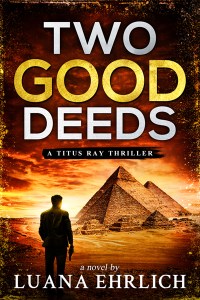
Book 7 in the Mylas Grey Mystery Series on Amazon. Click cover.

Book 4 in the Silas McKay Suspense Series on Amazon. Click cover.

Book 10 in the Titus Ray Thriller Series on Amazon. Click cover.

PREQUEL to the Mylas Grey Mystery Series on Amazon. Click cover

Book VI in the Mylas Grey Mystery Series on Amazon. Click cover

Book III in the Silas McKay Suspense Series on Amazon. Click cover

Book IX in the Titus Ray Thriller Series on Amazon. Click cover

Book V in the Mylas Grey Mystery Series on Amazon. Click cover

Book II in the Silas McKay Suspense Series on Amazon. Click cover

Book I in the Silas McKay Suspense Series, Available in Winter Deceptions

Ben in Trouble follows Four Steps Missed in the Titus Ray Thriller Series

Book IV in the Mylas Grey Mystery Series on Amazon. Click cover

Book VIII in the Titus Ray Thriller Series on Amazon. Click cover.

Ben in Charge, Follows Three Steps Away in the Titus Ray Thriller Series

Ben in Love, Follows Two Steps Forward in the Titus Ray Thriller Series

Two Days Taken:Book II in the Mylas Grey Mystery Series; Click cover.

Book VII in the Titus Ray Thriller Series on Amazon. Click on book cover

One Day Gone: Book I in the Mylas Grey Mystery Series; Click on Cover

NEWEST BOOK: Available on Amazon. Click on Cover.

Prequel to the Titus Ray Thriller Series is $0.99 on Amazon. Click book cover


Book I in the Titus Ray Thriller Series on Amazon. Click book cover


Book II in the Titus Ray Thriller Series on Amazon. Click on book cover

Book III in the Titus Ray Thriller Series on Amazon: Click on book cover


Book IV in the Titus Ray Thriller Series on Amazon. Click on book cover.


Book V in the Titus Ray Thriller Series on Amazon. Click on book cover.


Book VI in the Titus Ray Thriller Series on Amazon. Click on book cover.


Books 1 & 2 in the Titus Ray Series Available on Amazon. Click on cover.


 His Glory My Joy, a blog of Author Luana Ehrlich
You must be logged in to post a comment.