Archive
An Indescribable Gift

Mary gazes down on sweetness in a manger,
Bright eyes, soft skin, pure delight,
A gift from heaven.
John sees the Lamb at the Jordan,
Without spot, without blemish, without sin,
A gift from heaven.
Nicodemus questions the Rabbi in darkness,
New answers, fresh hope, glad heart,
A gift from heaven.
Zacchaeus climbs the sycamore tree,
Delighted, repentant, forgiven,
A gift from heaven.
The Savior dies on a Roman cross,
Bloodied, rejected, scorned,
A gift from heaven.
A sinner hears a message full of grace,
Good tidings, great joy, blessed hope,
A gift from heaven.
“Thanks be to God for His indescribable gift.” 2 Corinthians 9:15
It’s a Joy Thing

Whether you spend time reading the Bible on a daily basis, or you’re only familiar with it from hearing a minister preach from the Bible, you can’t miss the fact that joy is one of the predominate themes in the Bible.
Depending on which Bible translation you’re using, there are over 200 verses that talk about experiencing joy, which I would define as a deep sense of well-being that comes from knowing Christ through the presence of his Holy Spirit.
Joy isn’t happiness, which is a temporary emotion based on outward circumstances which brings pleasure or satisfaction for a short length of time and can easily disappear when a situation changes.
Instead, joy is rock solid, permanent, anchored in the unchanging nature and promises of God and expresses itself outwardly through our prayers and praises to Him.
Here are a few instances of what the Bible says about how we experience joy:
Joy is found in God’s presence
“You make known to me the path of life; in your presence there is fullness of joy; at your right hand are pleasures forevermore.” Psalm 16:11.
Joy is found in believing God
“May the God of hope fill you with all joy and peace in believing, so that by the power of the Holy Spirit you may abound in hope.” Romans 15:13.
Joy is found in worshiping God
“Shout for joy in the Lord, O you righteous! Praise befits the upright.” Psalm 33:1.
Joy is found in hearing the words of God.
“These things I have spoken to you, that my joy may be in you, and that your joy may be full.” John 15:11.
This deep, abiding joy is exclusively given to those who are believers in Christ, who have trusted His death on the cross as the ultimate sacrifice to pay for their sins, and who are anticipating spending an eternity basking in the light of His glorious beauty.
“And the ransomed of the Lord shall return and come to Zion with singing; everlasting joy shall be upon their heads; they shall obtain gladness and joy, and sorrow and sighing shall flee away.” Isaiah 51:11
Need A Blessing?

When a stranger suddenly sneezed when I was standing in front of her in the check out line at a grocery store, I responded by saying, “Bless you.”
She nodded and said, “Thank you. I needed a blessing.”
Her response amused me, and as I thought about this encounter later in the day, I was curious why we say, “God bless you,” or “Bless you,” when a person sneezes.
Naturally, that led me to do a little research on it, and I discovered this practice started during the Bubonic Plaque in Europe when sneezing was seen as a symptom of the disease. Saying, “God bless you,” was a way of asking God’s protection from the disease.
As believers in Christ, we don’t have to wait for a stranger to ask God’s blessings on us after a sneeze.
We can ask God to bless us at any time, at any place, and under any circumstance.
Matthew 7:7 tells us to “Ask, and it will be given to you; seek, and you will find; knock, and the door will be opened to you.”
An Old Testament character named Jabez asked for God’s blessing in this way: “Oh that you would bless me and enlarge my border, and that your hand might be with me, and that you would keep me from harm so that it might not bring me pain!” 1 Chronicles 4:9-10.
Before asking for God’s blessing, think of all the ways He’s already blessed you—salvation, family, career, shelter, health—and then be specific in the way you want Him to bless you now.
In asking for anything from the Lord, the Bible admonishes us to examine our motivation for asking—is it in keeping with God’s will for our life and the holy life he expects us to live as His children? How do we intend to use God’s blessing—for ourselves or for others?
One of the prayers of the Apostle Paul is a good guide to follow: “God, bless me abundantly, so that in all things at all times, having all that I need, I will abound in every good work.” 2 Corinthians 9:8.
My blessing for you today is this: “The Lord bless you and keep you; the Lord make his face shine on you and be gracious to you; the Lord turn his face toward you and give you peace.” Numbers 6:24-26.
I’m Not Able

When someone makes the statement, “I’m not able,” it can be an admission of weakness, but it can also be an admission of faith.
When a person realizes they’re not able to stand before God as blameless, they’re not expressing weakness; they’re validating the truth of Romans 3:23: “For all have sinned and fall short of the glory of God.”
But that’s not the full story. Even though everyone has sinned, Hebrews 7:25 tells us that Jesus, the Son of God, “is able to save to the uttermost those who draw near to God.”
And there’s this from Jude 24, where the writer says that Jesus “is able to keep you from stumbling and to present you blameless before the presence of his glory with great joy.”
Admitting I am not able to deliver myself from my sins, nor appear before God as blameless, is an expression of faith, and accepting the truth that He is able—by means of His sacrificial death—to accomplish it, is a confession of that faith.
But that’s still not the full story. In 1 Timothy 4:12, the apostle Paul says, “I know whom I have believed, and I am convinced that he is able to guard until that day what has been entrusted to me.”
And lastly, from Hebrews 2:18: “For because he himself has suffered when tempted, he is able to help those who are being tempted.”
I am not able, but God is able.
He is able to save those who come to Him.
He is able to keep you from stumbling.
He is able to present you as blameless.
He is able to guard you.
He is able to help you in temptation.
As the apostle Paul urges us in Ephesians 3:20-21, we give Him glory for He is able.
“Now to him who is able to do far more abundantly than all that we ask or think, according to the power at work within us, to him be glory in the church and in Christ Jesus throughout all generations, forever and ever. Amen.”
Let’s Talk Happiness

It’s been a cold, rainy week in Oklahoma. Not much sunshine. I’m not a person who gets depressed, and I really like some rainy days every now and then, but I’ve been longing for sunshine for two days now. People seem to be happier when the sun is shining.
As I thought about what makes people happy, I came across a devotional that references mankind’s universal search for happiness.
In the article, a book by C. S. Lewis called Mere Christianity is referenced. Here are two quotes from it that I believe give clarity and substance to the idea of happiness.
“All that we call human history–money, poverty, ambition, war, prostitution, classes, empires, slavery–is the long terrible story of man trying to find something other than God which will make him happy.”
“God designed the human machine to run on Himself. He Himself is the fuel our spirits were designed to burn, or the food our spirits were designed to feed on. There is no other. That is why it is just no good asking God to make us happy in our own way without bothering about religion. God cannot give us a happiness and peace apart from Himself, because it is not there. There is no such thing.” –C.S. Lewis, Mere Christianity.
A bright cloudless day can’t really make a person happy. Only God can do that.
Turn your face toward the Son. Bask in the warmth and happiness of His Light today.
“You make known to me the path of life, in your presence there is fullness of joy; at your right hand are pleasures forevermore.” Psalm 16:11.
To Know Him is to Fear Him
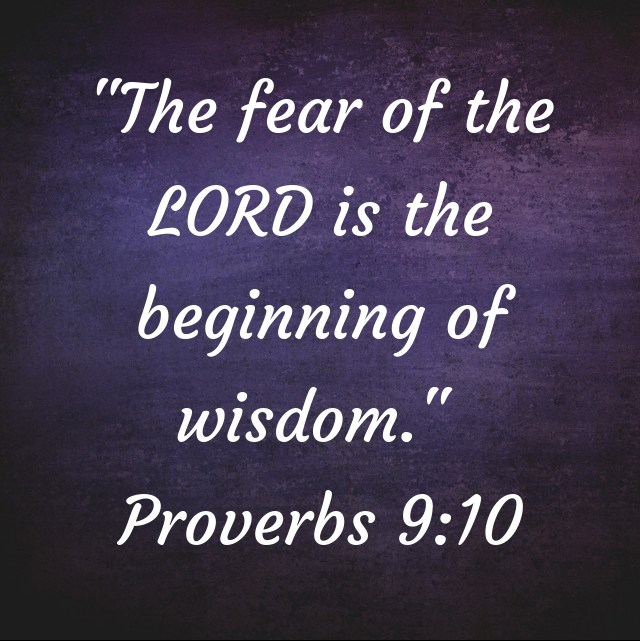
Be afraid. Be very afraid. Being afraid of God seems foreign to those of us who sing of His blessings, who trust Him with our eternal soul, and who pray daily to Him for guidance, for help, for comfort.
Yet, one can’t read the Bible without encountering the oft-repeated admonition to “fear the Lord.” Throughout the Old Testament, there are numerous examples of God’s children receiving a blessing because they fear God. Also, because of fearing God, they do what He commands them to do. (Genesis 42:18; Exodus 1:17; Exodus 18:21)
Fear of God is not just an Old Testament concept. Jesus said in Matthew 10:28, “Don’t be afraid of those who want to kill your body; they cannot touch your soul. Fear only God, who can destroy both soul and body in hell.”
Nevertheless, there are times in my life when I’ve struggled with the concept of what it means to fear God. Yet, I’ve come to realize that having a fear of God gives us a more realistic view of God’s holiness and His power.
Fearing God doesn’t mean we cower in His presence—like a dog who knows he’s displeased his master—nor does it mean we run and hide instead of joyfully approaching Him. Instead, we embrace the fear of God because we recognize His characteristics—His all-powerful wrath toward sin, His unending sovereignty, and His unapproachable holiness—are an accurate understanding of who God really is.
The fearfulness of God is a reality, even if we don’t like it very much.
Having a true picture of God is the beginning of wisdom. Proverbs 9:10: “The fear of the LORD is the beginning of wisdom, and the knowledge of the Holy One is insight.”
We should fear God. We should be in awe of His wrath and His judgment. Yet, at the same time, we should have peace, knowing He is shielding us from wrath, sheltering us in His arms forever.
THE BIG THANK

If I was restricted to only ONE THANK,
to whom would my BIG THANK go?
I’d give it to the ONE who deserves it all.
THANK YOU for being a
grace-giving,
faith-making,
man-saving,
love-providing,
sin-forgiving,
need-supplying,
pride-killing,
joy-flowing,
decision-guiding,
universe-creating,
disease-healing,
sorrow-lifting,
gift-imparting,
eternity-sharing,
GOD
Hidden in Plain Sight

Because I write mystery/suspense/thrillers, I’m always doing research on technology like hidden cameras, spy drones, and everyday objects that can be used for surveillance. Do you know the very best place to hide something? Hide it in plain sight. People tend to overlook things that are right in front of them.
How many people look at a button on a shirt and think it could be a hidden camera? No one but a spy or a thriller writer, which is all the more reason why it’s the perfect spot for one.
But “hidden in plain sight” doesn’t just apply to spies and detectives and hidden cameras. There are all kinds of hidden words for us in Scripture—staring us right there in the face just waiting for us to discover them.
I recently discovered one of these hidden jewels in Jude. Jude? That’s right. No wonder I’ve overlooked it. How often do you read from the book of Jude? It’s the book just before Revelation, so small it doesn’t even have chapters.
Here’s a “hidden in plain sight” treasure from Jude 24-25: “Now to him who is able to keep you from stumbling and to present you blameless before the presence of his glory with great joy, to the only God, our Savior, through Jesus Christ our Lord, be glory, majesty, dominion, and authority, before all time and now and forever.”
There are several reasons why these verses got my attention, but here are just three of them: 1) God not only helps us as we struggle with sin, He’s “able to keep us from stumbling.” 2) When we appear before Him in His presence, He’ll present us blameless in His sight. 3) When he presents us blameless before His presence, he’ll do it “with great joy.”
Okay, here’s one more: So often, we think of Jesus as our Savior, and rightly so, for his sacrifice on Calvary “saved” us from the wrath of God we all deserve. Yet Jude 25 calls God the Father our Savior: “to the only God, our Savior . . .”
No wonder Jude ends his letter with a praise to Him that we give him “glory, majesty, dominion, and authority . . .”
There you go—a magnificent truth hidden in plain sight for you to treasure and enjoy.
Oh, the voices!

Voices! We hear voices each and every day. They tell us to order this, pay attention to that, go there, come here.
Other voices post on our Facebook page, our Twitter feed, our social media sites, wanting us to sign this, like that, watch that, play this.
Who merits our attention? Whose voice is the worthy voice?
A crippled old man appears in the gospel of John to answer these questions. (John 5:1-17).
He doesn’t have a name in the gospel, but everyone at the pool of Bethesda knew him. He’d been lying there for thirty-eight years, unable to take advantage of the pool’s healing properties. Then Jesus stopped by one day, and, in one instantaneous moment, He took care of the crippled man’s lifelong problem.
Following Jesus’ instructions, the Man Made Whole gathered up his bedroll and walked away. Later, when asked by the religious leaders what he thought he was doing carrying around his bed on a Sabbath, he told them he was doing what he’d been instructed to do by the man who’d healed him, by the man who had enough authority to make him whole again.
The Man Made Whole was carrying his bed—in defiance of the religious authorities—because he recognized someone who was able to give life to his withered limbs was someone with authority, someone worthy of his attention.
This same man, this Jesus of Nazareth, healed me one day. He healed me of a lifelong sin problem, a sickness so severe I was doomed for eternal destruction. He did so by taking sin’s disease on Himself and paying the price for it Himself. Now, he commands me to take up my life and live it for Him.
His voice is a voice worth hearing.
Listen to His words from the rest of John 5, “Truly, truly, I say to you, an hour is coming, and is now here, when the dead will hear the voice of the Son of God, and those who hear will live. For as the Father has life in himself, so he has granted the Son also to have life in himself.” (25-26)
Who’s in Charge?
 As I was viewing posts on a writer’s site describing the results of methods used to advertise a new book’s release, I ran into a common theme–frustration and discouragement.
Some authors lamented their publishers weren’t being aggressive enough in advertising their latest release. Others felt their own methods had failed to generate sufficient sales. Yet, both were engaged in time-tested efforts book publishers usually employed to market books, getting them in the hands–and, thus, the hearts–of readers.
Since all my spy novels are in the Christian fiction category, what interested me most about these posts were comments by Christian authors. Several of them posted they had felt led of the Lord to write their book, yet many posted they weren’t happy about they way the book was selling. Did that mean they felt He wasn’t in command of how their book was selling, even though God had been in charge of writing their book?
Sometimes, when it appears God is leading us in one direction and we commit to that course of action, the results are not what we anticipated. We expected success, and we experienced failure–or, at least, less than successful results.
I believe this is a common misconception when it comes to feeling led of the Lord to do something.
Just because I felt led of the Lord to initiate a project, support a cause, or engage in some personal pursuit, and His hand was on me in the doing of it, that doesn’t mean, when it comes to the results, I’m suddenly in charge.
God is still in charge when it comes to all outcomes–not me and not you. Proverbs 16:9, “The heart of man plans his way, but the Lord establishes his steps.”
This is a common theme throughout the Scriptures, but as self-sufficient, self-determining human beings, we failed to remember or perhaps just refuse to heed, what the Lord is saying to us on the subject of who’s in charge.
Isaiah 55:8-11, “For my thoughts are not your thoughts, neither are your ways my ways . . . it shall accomplish that which I purpose, and shall succeed in the thing for which I sent it.”
What are your plans today? Will God be responsible for the results or will you decide to assign the blame–or maybe even the credit–to yourself?


Book 8 in the Mylas Grey Mystery Series, Click on cover

Book 5 in the Silas McKay Suspense Series, Click on cover

Book 11 in the Titus Ray Thriller Series. Click cover
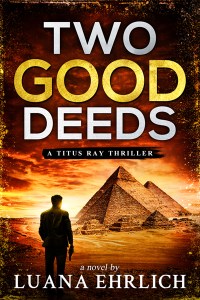
Book 7 in the Mylas Grey Mystery Series on Amazon. Click cover.

Book 4 in the Silas McKay Suspense Series on Amazon. Click cover.

Book 10 in the Titus Ray Thriller Series on Amazon. Click cover.

PREQUEL to the Mylas Grey Mystery Series on Amazon. Click cover

Book VI in the Mylas Grey Mystery Series on Amazon. Click cover

Book III in the Silas McKay Suspense Series on Amazon. Click cover

Book IX in the Titus Ray Thriller Series on Amazon. Click cover

Book V in the Mylas Grey Mystery Series on Amazon. Click cover

Book II in the Silas McKay Suspense Series on Amazon. Click cover

Book I in the Silas McKay Suspense Series, Available in Winter Deceptions

Ben in Trouble follows Four Steps Missed in the Titus Ray Thriller Series

Book IV in the Mylas Grey Mystery Series on Amazon. Click cover

Book VIII in the Titus Ray Thriller Series on Amazon. Click cover.

Ben in Charge, Follows Three Steps Away in the Titus Ray Thriller Series

Ben in Love, Follows Two Steps Forward in the Titus Ray Thriller Series

Two Days Taken:Book II in the Mylas Grey Mystery Series; Click cover.

Book VII in the Titus Ray Thriller Series on Amazon. Click on book cover

One Day Gone: Book I in the Mylas Grey Mystery Series; Click on Cover

NEWEST BOOK: Available on Amazon. Click on Cover.

Prequel to the Titus Ray Thriller Series is $0.99 on Amazon. Click book cover


Book I in the Titus Ray Thriller Series on Amazon. Click book cover


Book II in the Titus Ray Thriller Series on Amazon. Click on book cover

Book III in the Titus Ray Thriller Series on Amazon: Click on book cover


Book IV in the Titus Ray Thriller Series on Amazon. Click on book cover.


Book V in the Titus Ray Thriller Series on Amazon. Click on book cover.


Book VI in the Titus Ray Thriller Series on Amazon. Click on book cover.


Books 1 & 2 in the Titus Ray Series Available on Amazon. Click on cover.


 His Glory My Joy, a blog of Author Luana Ehrlich
You must be logged in to post a comment.