I Wear A Dusty Crown

I love the way David describes how God treats His children in Psalm 103. David says He “satisfies your desires with good things.”(Psalm 103:5).
Later on in this Psalm, David writes, “He remembers we are but dust.” He writes this in connection with the compassion of God. “As a father has compassion on his children, so the Lord has compassion on those who fear him; for he knows how we are formed, he remembers we are but dust.” (Psalm 103:13-14).
God created human beings out of a common substance, a substance of little worth, just a handful of dirt. Inside this dirt-formed vessel, He placed an image of Himself. When a handful of dirt became a man, something of little value became something of infinite value—a living human being. Every human being born after Adam reflects this God-likeness.
Even though we bear His likeness, we’re still just dirt. He remembers this. He knows our frailties and all our weaknesses. He knows our dirt. He has compassion on our dirt. The Psalmist says, “He crowns you with love and compassion.” (Psalm 103:4).
Even though we’re made of dirt, we have a regal bearing. As God’s children, we wear the crown of His compassion and love.
Perhaps this is why David begins and ends this Psalm with these words. “Praise the Lord, my soul; all my inmost being, praise his holy name.” (Psalm 103:22).
Read a Personal Story
 What’s the right way to read the Bible this year? You’ll find the answer in the Bible!
David, speaking in Psalm 16:11, says, “You make known to ME the paths of life.” David has a personal relationship with God. While it’s true the Bible has a message for all people, God intends for that message to be understood and received by each individual personally.
I read through the Bible every year, and I’ve used a variety of Bible Reading Plans to do this, but no matter which method I use, I try to make it personal by making notes in the margins.
You can easily make the Scriptures personal by asking this one question at the end of your Bible reading:
What message does God want me to take away from this passage?
For a great selection of various Bible Reading Plans, click here.
What Love Is This?
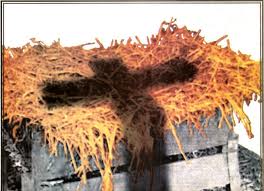
God’s love for you can never be restrained.
It bursts forth in smiles
from a cattle stall.
It shouts out in praise
from a heavenly host.
It cries out in anguish
from an old rugged cross.
Just A Little Nudge
 Sometimes, all it takes is a nudge. I’m especially susceptible to nudges. I probably wouldn’t have started writing my Titus Ray Thrillers, if someone hadn’t casually mentioned to me I should try writing a spy novel. Every day I enjoy a few minutes of mind-stimulating fun playing a word game on my iPad called Word with Friends, but if a very good friend hadn’t given me a little push to put the app on my iPhone, I wouldn’t have done so.
And, sometimes, a little nudge may be all a person needs to come to Christ, or to renew their commitment to Him, or to read their Bible or to . . .
Last week, I heard about a style of evangelism that’s become popular after a book was written about it five years ago. The book is called Nudge by Leonard Sweet. In it, Sweet says that “sharing the gospel should be a matter of awakening each other to the God who’s already there.”
Sweet writes, “Nudge evangelism is based on a simple premise: in everyone you meet, leave an impression–a Jesus impression, a Jesus dent. The nudge can be as simple as a smile, as profound as a prayer, as complex as a meal, as subtle as a story, as venturous as a witness, as ambitious as an altar call.”
To nudge someone toward Christ is vastly different from shoving them toward Christ. The gospels give a clear picture of how Jesus offered Himself to unbelievers. “Come unto me,” He said. If someone rejected the offer, Jesus was saddened by such a response, but He didn’t call them out, pronounce curses on them, or show animosity of any kind toward them. And yet, more than any other being in existence, He would have been justified in doing so.
Nudging people toward Christ can happen all the time in hundreds of different ways, and the form it takes is totally dependent on a person’s personality type. Extroverts will be more aggressive in calling attention to how Jesus is working in their lives but the quiet, thoughtful attitude of an introvert can be equally as effective.
As long as I keep one thing in mind, it’s easy for me to practice this kind of nudge evangelism. I remind myself that every person I encounter in my life—from grocery clerk to business man, from stranger to friend—is someone God has placed there, is someone God has prepared for me to nudge toward Him, is someone He loves.
Give someone a little nudge toward Jesus today. It may be all they need to discover the hidden treasure of Christ Himself.
1 Peter 2: 15-16 “For this is the will of God, that by doing good you should put to silence the ignorance of foolish people. Live as people who are free, not using your freedom as a cover-up for evil, but living as servants of God.”
And Now For Something Useless
 I was standing beside an elevator, having just pushed the Arrow Down button to call the elevator up to the second floor, when an elderly gentleman walked over and pushed the same button again. Then, he turned to me and said, “I know that was useless. The elevator won’t get here any sooner just because two people push it.”
At the grocery store, a little later that day, I tried to sign my name on a credit card scanner. After several attempts to make a semi-legible mark, the clerk waved her hand at me and said, “Oh, honey, forget it. Your signature won’t mean anything on there. That thing is useless.”
My day of useless things ended when I got home and tried to balance my checkbook. No, it wasn’t balancing the checkbook that proved useless. What was useless was pushing the “C” repeatedly on the calculator, clearing out the old amount before adding a new one. Like the gentleman at the elevator, I suddenly realized pressing the “C” a second time was an exercise in futility. The screen always went blank the first time I pushed it.
There’s a fourth useless thing we may be guilty of as well. It’s forgetting to worship our Creator. God reminds us of this in Isaiah 45:7 when He says, “I form light and create darkness, I make well-being and create calamity, I am the Lord, who does all these things.”
Failure to acknowledge the God of the Universe, He who created light and darkness, who directs every aspect of our lives, is useless. In the same chapter in Isaiah, God says,” By myself I have sworn; from my mouth has gone out in righteousness a word that shall not return:‘To me every knee shall bow, every tongue shall swear allegiance.” (Isaiah 45:23).
Now That’s Good Advice!
 Here are four pieces of advice I wish I’d been given much earlier in life.
1. Your greatest asset isn’t your own abilities. While you may have been told all you need to do is work hard and keep on keeping on, don’t believe it. Your greatest asset is your utter dependence on God. “Apart from me, you can do nothing.” John 15:5.
2. Your desire to have applause isn’t in keeping with the gospel. While our sinful nature is bent toward making much of ourselves and looking out for our own interests, the gospel tells us to make much of Jesus and look out for His Kingdom. “But seek first the kingdom of God and his righteousness, and all these things will be added to you.” Matthew 6:33.
3. You have no idea what God is doing in your life. There’s no blueprint, formula, or method out there which will enable you to gauge what God is doing in your life. It simply doesn’t exist. If it did, you wouldn’t rely on God when He takes you to places you wouldn’t ordinarily go and has you do things you aren’t equipped to handle. God is too delighted in seeing your faith grow to tell you what He’s up to. Most of what He’s doing can only be understood through a rear view mirror. “For we walk by faith, and not by sight.” 2 Corinthians 5:7.
4. You could be one incredible piece of work if you’re willing to admit you’re not. If God’s Word is any gauge of how God operates–and it most definitely is–then He uses the weak, the nobody, the frightened soul, the lowly, and the despised to be a blessing and give Him glory. If you’re willing to be a piece of clay in the potter’s hands, He’s willing to fashion you into a beautiful vessel for His Kingdom’s work. “But now, O Lord, you are our Father; we are the clay, and you are our potter.” Isaiah 64:8.
Secrets Are The Best!
 Everyone loves a secret. Whisper a secret to a group of children, and immediately their eyes light up. However, children don’t have a corner on the secrets market. Adults love to hear secrets almost as much as children love to tell them.
God has secrets—boy, does He have secrets! As if we didn’t know this already, the Bible tells us so.“The secret things belong to the Lord our God, but the things that are revealed belong to us and to our children forever, that we may do all the words of this law.” (Deuteronomy 29:29)
When God came in the flesh in the person of Jesus, He revealed His secrets in a form mankind had never seen before. John 1:18, “No one has ever seen God; the only God, who is at the Father’s side, he has made him known.”
Jesus revealed many secrets to his disciples. He even revealed explicit details about his upcoming death. Matthew 20:18-19, “We are going up to Jerusalem, and the Son of Man will be delivered over to the chief priests and the teachers of the law. They will condemn him to death and will hand him over to the Gentiles to be mocked and flogged and crucified. On the third day he will be raised to life!”
God even gave us a promise about His secrets: “For the Lord GOD does nothing without revealing his secret to his servants the prophets.” (Amos 3:7)
Every secret God wants us to know, He’s already revealed through his prophets. Just to make sure those of us living in this century would have access to those secrets, He had His prophets write them down.
So, you wanna know a secret? Just read His Word. There you’ll find the best-kept secrets!
Feeling a Little Blurry Around the Edges?
 One of the great things about the cell phone cameras we use today is the automatic focusing feature. I’m old enough to remember using an actual camera that required fiddling with a bunch of dials before snapping the picture. Most of the time, those waiting to be photographed weren’t very patient about this process, and, oftentimes, after all that effort, the photo turned out to be out of focus after all.
As children of God, it would be nice to have this automatic focusing mechanism built into our daily lives, so that the moment our lives became blurry around the edges—from taking part in all the world has to offer, from neglecting Bible study, from participating in non-glorifying activities—then our focus would automatically be returned to our Father and to living out Christ in us, “the hope of Glory” (Colossians 1:27).
However, none of us have an automatic focusing mechanism. What we have is something even better—the Word of God.
While having a device to automatically redirect one’s focus towards God sounds good, in reality, such a device would ultimately lead to taking God for granted, and it wouldn’t adhere to the command to “work out your salvation with fear and trembling” (Philippians 2:12).
God’s Word directs us to focus on Him in numerous passages of Scripture throughout the Old and New Testament.
One of my favorites is 2 Thessalonians 3:5: “May the Lord direct your hearts to the love of God and to the steadfastness of Christ.”
Have you lost your focus? Direct your heart today to the love of God. “The love of God was made manifest among us, that God sent his only Son into the world, so that we might live through him” (1 John 4:9).
Direct your heart to the steadfastness of Christ. “He who calls you is faithful; he will surely do it” (1 Thessalonians 5:24).
Spending time with the Lord in daily Bible study brings clarity to our lives and sharpens an otherwise blurry picture.
What Story Will You Tell?
 All of us have a story. It may be your parenting story, your pregnancy story, your career story or the story of your life. A story I’ve always enjoyed hearing is the story of someone’s salvation—all the details surrounding how a person came to faith in Christ.
When we lived in Indiana back in the late 1980’s, the editor of our denomination’s weekly state paper, The Indiana Baptist, asked me to do a weekly column on a different individual each week and emphasize the details of their conversion experience. I decided to call the column “A Story To Tell.”
My husband’s job at that time was in Baptist missions, and we traveled to a different church in Indiana every week. We usually arrived at the church at least an hour before he was to preach, so I had time to seek out a friendly man or woman, get their permission to record our conversation, and then ask them to tell me their salvation experience. After the interview, I would write down our conversation in a story format.
While all the stories culminated when the person became a born-again Christian, each convert’s circumstances were unique. However, after several months of writing salvation stories, the common thread I saw in each person’s experience was the way God used a friend, a neighbor, a relative, or even a stranger to draw the unsaved person to Christ.
An example of this was the young man who had not been brought up in the church, knew nothing of the Lord and was planning on becoming a professional golfer. One evening, when he was about to enter a nightclub to enjoy several hours of partying, he noticed a group of people carrying picket signs. They were protesting what was going on inside the establishment. One of the signs read “The wages of sin is death.”
For weeks the young man was haunted by these words, but he had no idea what they meant. However, after he followed his girlfriend’s suggestion to talk to a pastor, he was led to the Lord, and his life was forever transformed.
I’m sure the man who had picketed the nightclub that night carrying a sign with the words from Romans 6:23 written on it, never realized his small gesture eventually made an eternal difference in someone’s life.
What difference will you make in someone’s salvation story?
What’s Your Name?
 Deciding what to name a child can be challenging. While I’ve passed the stage of naming babies, today, I’m faced with what to name a character in a book. That too can prove challenging.
When a character enters a scene, the person’s name usually pops in my head at the same time. However, before accepting this moniker as the appropriate tag for the person, I do a little research just to make sure it isn’t the name of a celebrity or a politician or some other famous person.
I also want a villain’s name to sound . . . well . . . villainous, and a strong character to have a strong sounding name. Think “Rocky” and you get the picture.
The Bible is full of great names for both babies and characters. These are names that have been around for thousands of years, and have quite literally stood the test of time. But, there are many “one time use” names in the Bible as well.
For instance, in the book of Hosea, God instructs a prophet to name his daughter “No Mercy” (Hosea 1:6). The son who came later was named “Not My People” (Hosea 1:9). Their Hebrew names Lo-ruhama and Lo-ammi never quite caught on as popular names for offspring, but those names portrayed the message God was endeavoring to send His people at that time.
In the book of Ruth, a widow named Naomi, who had lost two sons, decided she wanted to be called Bitter. She wanted this name change because she said, “the Almighty has dealt bitterly with me” (Ruth 1:20).
If you wanted a name to reflect how God has dealt with you, what would you call yourself?
I would call myself Blessed. I pray it would be your name as well. We are all Blessed.
“Blessed is he whose help is the God of Jacob, whose hope is in the Lord his God.”
Psalm 146:5


Book 8 in the Mylas Grey Mystery Series, Click on cover

Book 5 in the Silas McKay Suspense Series, Click on cover

Book 11 in the Titus Ray Thriller Series. Click cover
Book 7 in the Mylas Grey Mystery Series on Amazon. Click cover.

Book 4 in the Silas McKay Suspense Series on Amazon. Click cover.

Book 10 in the Titus Ray Thriller Series on Amazon. Click cover.

PREQUEL to the Mylas Grey Mystery Series on Amazon. Click cover

Book VI in the Mylas Grey Mystery Series on Amazon. Click cover

Book III in the Silas McKay Suspense Series on Amazon. Click cover

Book IX in the Titus Ray Thriller Series on Amazon. Click cover

Book V in the Mylas Grey Mystery Series on Amazon. Click cover

Book II in the Silas McKay Suspense Series on Amazon. Click cover

Book I in the Silas McKay Suspense Series, Available in Winter Deceptions

Ben in Trouble follows Four Steps Missed in the Titus Ray Thriller Series

Book IV in the Mylas Grey Mystery Series on Amazon. Click cover

Book VIII in the Titus Ray Thriller Series on Amazon. Click cover.

Ben in Charge, Follows Three Steps Away in the Titus Ray Thriller Series

Ben in Love, Follows Two Steps Forward in the Titus Ray Thriller Series

Two Days Taken:Book II in the Mylas Grey Mystery Series; Click cover.

Book VII in the Titus Ray Thriller Series on Amazon. Click on book cover

One Day Gone: Book I in the Mylas Grey Mystery Series; Click on Cover

NEWEST BOOK: Available on Amazon. Click on Cover.

Prequel to the Titus Ray Thriller Series is $0.99 on Amazon. Click book cover


Book I in the Titus Ray Thriller Series on Amazon. Click book cover


Book II in the Titus Ray Thriller Series on Amazon. Click on book cover

Book III in the Titus Ray Thriller Series on Amazon: Click on book cover


Book IV in the Titus Ray Thriller Series on Amazon. Click on book cover.


Book V in the Titus Ray Thriller Series on Amazon. Click on book cover.


Book VI in the Titus Ray Thriller Series on Amazon. Click on book cover.


Books 1 & 2 in the Titus Ray Series Available on Amazon. Click on cover.


 His Glory My Joy, a blog of Author Luana Ehrlich
You must be logged in to post a comment.